Category Archives: Health

Day 2 at wind turbine appeal in London

Lawyers for four families battling wind projects in Southwestern Ontario continued their legal arguments this morning in a divisional court in London.

page_Wind_Turbines_110Lawyer Julian Falconer presented evidence from a Health Canada study into the effects of wind turbines before three Superior Court trial judges who are listening to an appeal of a decision of the Environmental Review Tribunal.

But while courts and judges and tribunal and appeals courts hear arguments, families aren’t getting any relief from their health concerns, Falconer said.

“There’s a whole process that takes a year to two years . . . health takes a back seat while the (wind) company goes and remodels. It’s business as usual while the company gets more reports,” he said.

Appeals and approvals of wind turbine projects have so far placed the onus on families to prove the turbines will have a negative effect on their health and the ERT grants turbine approvals even as it says the effects are unclear, Falconer said.

Falconer said there is new evidence that should be considered – a Health Canada study which looked at both self-reported health concerns and measurable health problems like blood pressure and stress-hormone levels in hair, in people who live close to projects in Ontario and Quebec.

“There is far more data than has been available to date,” Falconer said. “We submit that the ERT hearing wasn’t fair in the first place . . . and now we have a reason to hear it again.”

Lawyers for four families will also argue that the ERT decision had serious errors in law.

Also represented at the proceedings are the Ontario environment ministry, which is responsible for regulating Green Energy projects, including wind turbine applications, as well as three companies building or planning to build turbines projects near Goderich, Seaforth and Kincardine.

It’s unlikely the three-judge panel will get to the four defendants’ evidence today

Follow Tweets: Kate Dubinski, The London Free Press Tuesday, November 18, 2014

Take Poll: Poll Do you believe wind turbines affect human health?


For Media Release

MEDIA RELEASE – Nov 14, 2014
COALITION AGAINST INDUSTRIAL WIND TURBINES (CAIWT)
DIVISIONAL COURT CASE IN LONDON ONTARIO – November 17, 18, 19th

Fourteen concerned citizens groups from across Ontario have formed a “Coalition” that will ask to intervene on a
potentially precedent setting divisional court case involving industrial wind turbines. The group will seek to
intervene on the morning of November 17th in London, Ontario.

Start time on Monday morning is 10:00 a.m.

The Coalition is comprised of the following groups:
1. WAIT-PW (Plympton-Wyoming)
2. Central Bruce Grey Wind Concerns (HARM) Health Affected Residents Meetings – Municipality of Kincardine
3. Grey Highlands Wind Concerns (GHWC)
4. Casualties of Plateau Wind – Grey Highlands
5. Haldimand Wind Concerns
6. West Lincoln Glenbrook Wind Action (WLWAG)
7. Oppose Bellwood Wind Farm – County of Wellington, County of Dufferin
8. Bluewater Lakeshore Residents Association
9. Middlesex & Lambton Residents Group
10. Mothers Against Wind Turbines Inc – Niagara, West Lincoln, Haldimand
11. Central Huron Against Turbines Inc. (CHAT) – Central Huron
12. Manitoulin Coalition for Safe Energy Alternatives Inc – (MCSEA Inc) Manitoulin Island
13. Ripley Group – Huron Kinloss
14. V.O.W. Victims of Wind – Coordinated by an Ontario volunteer

The members of these groups represent communities throughout the province of Ontario, including the Niagara Region,
the Counties of Haldimand, Middlesex, Lambton, Norfolk, Wellington, Dufferin, the Municipalities of Kincardine,
Saugeen Shores, Grey Highlands, Northeastern Manitoulin and the Islands, Central Huron and the Township of West
Lincoln.

In regards to Industrial Wind Turbine Renewable Energy Approvals, the Environmental Review Tribunal appeals
involving the Drennans, Dixons and Ryans and the Kroeplins were all dismissed. The appellants in this divisional court
appeal will be represented by

Falconers LLP and will be heard over 3 days – November 17, 18, 19 at the court house at 80 Dundas Street, London Ontario. (parking and entrance off Queens Ave.)
CAIWT is represented by: Mr. Richard Macklin
Stevensons LLP
Barristers
15 Toronto Street
Toronto, ON
M5C 2E3
Lambton County will also be seeking intervener status with their own legal counsel.
For information on the divisional court case, please visit:
http://www.falconers.ca Coalition contact;
Falconers LLP Raymond Beaudry
10 Alcorn Avenue, Suite 204 Little Current, On
Toronto, ON 705-368-3328
M4V 3A9 MCSEA Inc
(416) 964-0495 mcsea.c


“Health Canada has failed totally and publicly with this report”

Dr. Robert McMurtry, the founding director of Wind Concerns Ontario, comments on the Health Canada Study of industrial wind turbines.

“Annoyance” IS “Adverse Health Effect” – “Adverse Health Effect” IS “Annoynace”

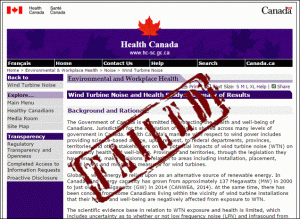
It has been said on W.H.O (WHealth Report Failureorld Health Organization and on the “Health Canada” Web site”

“Health Canada has failed totally and publicly with this report”

follow link to listen to the entire interview: GFB Podcast: Dr. Robert McMurtry – November 12th

Queen’s University professor disputes wind turbine report

One of the key experts backing opposition to a wind energy development on Amherst Island said a recent Health Canada study is more politics than science.

John Harrison, a Queen’s University professor emeritus in physics and a member of the Association to Protect Amherst Island, located near Kingston, Ont., said the report contradicts itself and was not peer reviewed.

In a report released last week, Health Canada said there is no link between noise from wind turbines and adverse health effects.

Health Canada scientists looked at communities that host wind farms. Two dozen government, academic and industry experts contributed to the study.

Researchers examined 1,200 participants living within 2 km of wind turbines in Ontario and P.E.I. Continue reading Queen’s University professor disputes wind turbine report

MAWT Inc., confirms they are appealing the NRWC project approval.

Green light for west Niagara wind turbine project

The company planning to build one of Canada’s largest industrial wind turbine farms in Niagara has been given the approval to move forward.

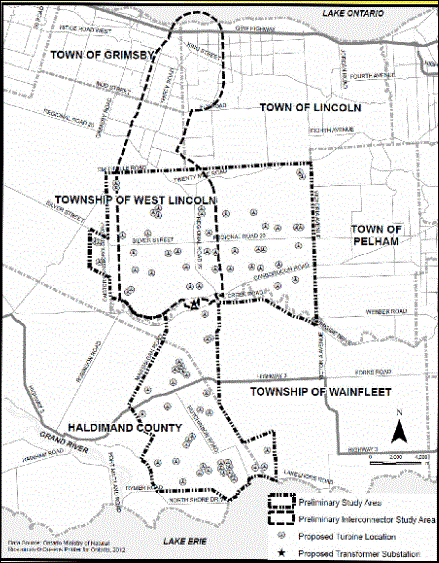
turbine mapNiagara Region Wind Corp. said Wednesday it is on track to build its 77-turbine wind farm in Niagara region and Haldimand county, after the Ministry of the Environment issued its Renewable Energy Approval last week.

The turbines being installed — the majority to be located in West Lincoln — are some of the largest available at three megawatts each. The total development has a capacity of 230 MW, enough to power 70,000 homes and make it the fifth-largest wind farm in North America.

“The is confirmation of all the work we’ve done over the past seven and a half years,” said Merv Croghan, CEO of NRWC.

But while the REA is one big hurdle, the private company is still a number of steps away from being able to start construction.

“We’re moving forward with our very detailed construction design plans,” Croghan said. “We’re getting into the real micro detailing of the project.”

NRWC is now in a 15-day holding period during which the public can submit objections on the REA approval. A panel would then decide if the approval should be heard before an environmental review tribunal, similar to an appeals court, to which the company would have to argue its case to move forward with the project.

At least one group, Mothers Against Wind Turbines (Inc.), confirmed Wednesday it plans to appeal.


“The reason for the appeal is to protect children and families in our communities against the wind turbine emissions,” said Linda Rogers, who sits on the Mothers Against Wind Turbines board.

In an NRWC news release, Croghan said the project would create more than 700 jobs during construction and that more than $130 million would be spent locally.

After the company issued its release Wednesday morning, Niagara West–Glanbrook MPP Tim Hudak, who has publicly opposed the project, said he would continue to fight against the Green Energy Act and the turbine developments it allows.

“I’m going to keep fighting this project,” he said in an e-mail to The Tribune. “It is not in the interest of local residents to have among the tallest wind farms forced into their backyards with no local say, nor does it help seniors, families and businesses who are now paying among the most expensive hydro bills in North America.”

Hudak said he has proposed a moratorium on the development of “any more heavily-subsidized wind energy projects” as part of a bigger affordable energy plan.

West Lincoln Mayor Doug Joyner was also disappointed to hear the project got its REA.

“Regardless of what position you have on wind farms, many West Lincoln residents, and many Ontario residents, still believe that the action of the provincial government to take away the rights of municipalities through the Green Energy Act is very disappointing and fundamentally wrong,” he said, adding that West Lincoln has declared itself an “unwilling host” to industrial wind farms.

“Council and many residents truly believe that (wind) farms should be directed to willing host communities,” he said.

Joyner called the combination of the REA approval and last week’s Health Canada study effectively backing the argument of the wind turbine developers a “double whammy.”

But Croghan said he sees the Health Canada report as confirmation of its own studies.

“It should be more confirmation for the public that a third party did studies. They should feel comfortable knowing that what we’ve said in our REA and what the MOE has approved, is factual,” he said.

Rogers, however, said that study doesn’t tell the whole story.

turbine size“The study is not complete. What has been issues are preliminary statements. There is a lot of criticism about those statements,” she said. “The (NRWC) project as currently approved will cause harm. The main mechanism will be noise. These are some of the largest wind turbines that have been sited in Ontario. The government knows there’s a problem. A big problem.”

Poll Do you agree with the development of industrial wind turbines in Niagara?

Dan Dakin, Welland Tribune Wednesday, November 12,

********************************************

Please donate to the Legal Fund so that MAWT Inc. can continue to fight the NRWC project…it’s not over till we send them packing.   

1000 families – $100….will you be one of the 1000?

send cheque to:

  • Mothers Against Wind Turbines
  • Box 132
  • Wellandport, ON
  • L0R 2J0


MAWT Inc. Supports Negative Critiques of the Health Canada Study.

MAWT Inc. would like to go on record and say that we have read and support the Denise Wolfe/Dr. McMurtry critiques of the Health Canada study as well as Carmen Krogh’s. 

DENISE WOLFE’S SUMMARY ON HEALTH CANADA,

 DR. ROBERT Y. MCMURTRY STATEMENT RELATED TO HEALTH CANADA STUDY AND DENISE WOLFE SYNOPSIS

Following Canada’s Wind Technology Roadmap and Health Canada’s Wind Turbine Noise and Health Study Carmen Krogh,BScPharm Brett Horner, BA CMA


The Negative Health Impact of Noise from Industrial Wind Turbines: The Evidence

Today’s post, the second of three installments, reviews the major research findings linking low-frequency noise and infrasound from industrial wind turbines with effects on health and quality of life.[1]  

By Jerry Punch, PhD, and Richard James, INCE, BME

jerry punch

Evidence that industrial wind turbines (IWTs) negatively impact human health is vast and growing. Although that evidence acknowledges that the exact exposures needed to impact health and the percentage of the affected population are still unknown, there is indisputable evidence that adverse health effects (AHEs) occur for a nontrivial percentage of exposed populations. Here, we give an overview of that evidence.[2]

Wind turbine noise is not known to cause hearing loss. Interestingly, though, individuals who have hearing disorders may be more susceptible than persons with normal hearing to AHEs from wind turbine noise, and people who are deaf can suffer the same ill effects as those who have normal hearing when exposed to wind turbine noise. The latter finding supports the view that infrasound, not just the audible whooshing, low-frequency noise emitted from wind turbines, is the cause of many of the health complaints.

Richard James

The anecdotal evidence, documented on internet blogs, innewspaper articles, in expert testimony in legal proceedings, and recently in the documentary movies Windfall and Wind Rush, is compelling and illustrative of the similarity in symptoms. These adverse symptoms appear when people are exposed to operating wind turbines, and disappear when the turbines stop operating. These observations resemble single-subject research experiments, in which individuals serve as their own controls while being subjected to alternating conditions or treatments. Dr. Carl Phillips, noted epidemiologist, describes the use of adverse event reporting as a first step in establishing the existence, prevalence, and spread of a variety of health conditions, as well as adverse reactions to such agents as medications and environmental pollutants.

Reports that many families abandon their homes after IWTs begin operation make the anecdotal evidence particularly compelling.

Studies conducted in Denmark, the Netherlands, Germany, and Sweden, where residents have many decades of experience with IWTs, collectively indicate thatwind turbine noise differs from and is more annoying than other sources of noise, including community, transportation, and industrial sources.

Continue reading The Negative Health Impact of Noise from Industrial Wind Turbines: The Evidence

Jane Wilson talks with Goldhawk about Health Canada report on the health effects of wind turbines

Jane Wilson

Jane Wilson, President of Wind Concerns Ontario, describes her disappointment with the Health Canada report on the health effects of wind turbines.

LISTEN TO POD CAST HERE

Industry Led – Government Supported

Following Canada’s Wind Technology Roadmap and Health Canada’s Wind Turbine Noise and Health Study

Carmen Krogh, BScPharm
Brett Horner, BA CMA
November 10, 2014

On November 6 2014 Health Canada posted on their website “Wind Turbine Noise and Health Study: Summary of Results”.

We have been contacted by individuals from around the world who have expressed  concern over content and the quality of this Health Canada web posting

“Wind Turbine Noise and Health Study: Summary of Results” states:

“WTN annoyance was found to be statistically related to several self-reporting health effects including, but not limited to, blood pressure, migraines, tinnitus, dizziness, scores on the PSQI, and perceived stress” as well as related to “measured hair cortisol, systolic and diastolic blood pressure.”

These findings are additional evidence which support the health effects “conclusively demonstrated from exposure to wind turbine noise” identified by Health Canada and disclosed by the Honourable Rona Ambrose in a June 30, 2009 letter.

In the upcoming weeks and months, it is our intention to release a series of commentaries and disclose information on the “Wind Turbine Noise and Health Study: Summary of Results” and the Health Canada Wind Turbine Noise and Health Study.

In the meantime we have compiled the following relevant information to help inform those interested in Health Canada’s Wind Turbine Noise and Health Study.

read further here: https://mothersagainstturbines.com/wp-content/uploads/2014/11/industry-led-government-supported_november-10-2014_release-final-1.pdf