Category Archives: Health effects from wind turbines

Legal battle over Ontario wind turbine farm may redefine ‘harm’

The right to be free from chronic annoyance is at the heart of a legal challenge that could shake Ontario’s multibillion wind-energy business, and limit other industrial development in rural areas.

Wind turbines spin at a wind farm on November 17, 2014 near Brieselang, Germany. Ontario has 62 separate wind farms approved or proposed, under rules that allow them to be built 550 metres from homes, and at a noise level of up to 40 decibels in rural areas – the level at which the adverse health effects of annoyance set in, according to the World Health Organization. (Sean Gallup/Getty Images)
Wind turbines spin at a wind farm on November 17, 2014 near Brieselang, Germany. Ontario has 62 separate wind farms approved or proposed, under rules that allow them to be built 550 metres from homes, and at a noise level of up to 40 decibels in rural areas – the level at which the adverse health effects of annoyance set in, according to the World Health Organization.
(Sean Gallup/Getty Images)

It pits a family whose farming history goes back a century in Southwestern Ontario against the provincial government, and a consortium known as the K2 Wind Power Project, which includes global companies such as Samsung Renewable Energy Inc.

No evidence shows wind turbines directly harm human health.

But “community annoyance” lasting a year or more and associated with nearby turbines has been linked to headaches, sleep problems, dizziness and high blood pressure, in a study whose summary was released by Health Canada early this month. Continue reading Legal battle over Ontario wind turbine farm may redefine ‘harm’

Wind turbines like ‘nightmare neighbours’ but law ‘rigged,’ court told

The Canadian Press - Shawn Drennan, part of a four-family fight against Ontario's wind-turbine legislation, is seen outside court in London, Ont., on Monday, Nov. 17, 2014. THE CANADIAN PRESS/Colin Perkel
The Canadian Press – Shawn Drennan, part of a four-family fight against Ontario’s wind-turbine legislation, is seen outside court in London, Ont., on Monday, Nov. 17, 2014. THE CANADIAN PRESS/Colin Perkel

The Canadian Press – Shawn Drennan, part of a four-family fight against Ontario’s wind-turbine legislation, is seen outside court in London, Ont., on Monday, Nov. 17, 2014. THE CANADIAN PRESS/Colin PerkelWind turbines are like new neighbours who might drive you to distraction and out of your home because you have no legal way to deal with the situation, a packed Ontario court heard Monday.

In submissions to Divisional Court, a lawyer for four families fighting large-scale wind-energy projects compared the turbines to a neighbour who is always noisy and in your face.

“This neighbour never once ruptured your eardrums but that neighbour slowly drives you crazy,” Julian Falconer told the court.

“These turbines are those nightmare neighbours.”

The families are trying to get the court to declare provincial legislation related to the approvals of large-scale wind farms unconstitutional.

In essence, they argue, the legislation makes it impossible to scuttle a project on the basis of potential health impacts.

“The priority is to get the turbines up come hell or high water and that’s what they do,” Falconer said.

read more: By Colin Perkel, The Canadian Press | The Canadian Press, Nov 17 2014

Ontario’s wind farm approval process faces constitutional challenge

Governments love windmills, people who live near them hate them. The result is a beautiful recipe for lawyers.

ulian Falconer, no stranger to public interest cases, represents families challenging the development of three wind farms near Lake Huron

Mr. Falconer is one of the country’s top constitutional and human rights lawyers. He represented the Smith family in a lawsuit into the death of Ashley Smith in custody. He worked on the Ipperwash Inquiry. He represented Maher Arar in a suit against the federal government over his rendition and torture in Syria. The list goes on. Point is, Mr. Falconer takes a special interest in holding government to account.

On Monday he’ll be taking on windmills. He wants Ontario’s Divisional Court to overturn the regulatory approvals of three projects, the St. Columban Wind and K2 Wind Energy project in Huron County, and the SP Armow Wind project near Kincardine, Ont.

His clients, who live near the projects, fear the noise and vibration of the wind turbines will trigger a host of serious health problems. Mr. Falconer will argue in court that Ontario’s process for approving wind farms violates the Charter of Rights and Freedoms. Provincial legislation says anyone challenging a wind farm project before Ontario’s Environmental Review Tribunal must prove “serious harm” to human health. Mr. Falconer says that threshold is unfair because it is too high.

“The effects of wind turbines are felt in the most private and personal areas of residents’ lives, in their homes and beds, where the state has its lowest interest in intrusion,” Mr. Falconer submits in his written argument.

The Charter argument is a fairly new wrinkle in the fight against wind farms. But litigation itself isn’t. When the Divisional Court rules on the appeal, its decision will join the more than 30 Canadian reported court cases that have dealt with wind turbines — a number that shoots to nearly 100 when you include hearings before Canadian regulatory tribunals.


Read MORE: Financial Post, Drew Hasselback | November 17, 2014 |

Press Release: WAIT-PW Comments on Turbine Health Study

Press Release:

Health Canada’s Wind Turbine Noise and Health Study: Summary of Results 1

Summary Statements [1]  regarding the above study were released this past week by Health  Canada; however, the study itself was not released.

Health Canada’s summary report on wind turbine noise and health confusing

Media timing issues relating to summary report release and issues with CANWEA press  release

Some summary statements indicate no association between wind turbine noise and health

Some summary statements appear to indicate an association between wind turbine noise and health

Reports immediately following Health Canada’s press advisory state no problems with wind  turbines

No peer reviewed study results released – caution advised in interpretation of summary  statements

Summary report statements appear “rushed” given no study or peer reviewed study available

Children, Noise, Annoyance, Respiratory Effects, World Health Organization

Click to access press_release.pdf

MAWT Inc. Supports Negative Critiques of the Health Canada Study.

MAWT Inc. would like to go on record and say that we have read and support the Denise Wolfe/Dr. McMurtry critiques of the Health Canada study as well as Carmen Krogh’s. 

DENISE WOLFE’S SUMMARY ON HEALTH CANADA,

 DR. ROBERT Y. MCMURTRY STATEMENT RELATED TO HEALTH CANADA STUDY AND DENISE WOLFE SYNOPSIS

Following Canada’s Wind Technology Roadmap and Health Canada’s Wind Turbine Noise and Health Study Carmen Krogh,BScPharm Brett Horner, BA CMA


The Negative Health Impact of Noise from Industrial Wind Turbines: The Evidence

Today’s post, the second of three installments, reviews the major research findings linking low-frequency noise and infrasound from industrial wind turbines with effects on health and quality of life.[1]  

By Jerry Punch, PhD, and Richard James, INCE, BME

jerry punch

Evidence that industrial wind turbines (IWTs) negatively impact human health is vast and growing. Although that evidence acknowledges that the exact exposures needed to impact health and the percentage of the affected population are still unknown, there is indisputable evidence that adverse health effects (AHEs) occur for a nontrivial percentage of exposed populations. Here, we give an overview of that evidence.[2]

Wind turbine noise is not known to cause hearing loss. Interestingly, though, individuals who have hearing disorders may be more susceptible than persons with normal hearing to AHEs from wind turbine noise, and people who are deaf can suffer the same ill effects as those who have normal hearing when exposed to wind turbine noise. The latter finding supports the view that infrasound, not just the audible whooshing, low-frequency noise emitted from wind turbines, is the cause of many of the health complaints.

Richard James

The anecdotal evidence, documented on internet blogs, innewspaper articles, in expert testimony in legal proceedings, and recently in the documentary movies Windfall and Wind Rush, is compelling and illustrative of the similarity in symptoms. These adverse symptoms appear when people are exposed to operating wind turbines, and disappear when the turbines stop operating. These observations resemble single-subject research experiments, in which individuals serve as their own controls while being subjected to alternating conditions or treatments. Dr. Carl Phillips, noted epidemiologist, describes the use of adverse event reporting as a first step in establishing the existence, prevalence, and spread of a variety of health conditions, as well as adverse reactions to such agents as medications and environmental pollutants.

Reports that many families abandon their homes after IWTs begin operation make the anecdotal evidence particularly compelling.

Studies conducted in Denmark, the Netherlands, Germany, and Sweden, where residents have many decades of experience with IWTs, collectively indicate thatwind turbine noise differs from and is more annoying than other sources of noise, including community, transportation, and industrial sources.

Continue reading The Negative Health Impact of Noise from Industrial Wind Turbines: The Evidence

Denise Wolfe’s summary on Health canada

This is a DRAFT (and far from exhaustive) review of the information provided by Health  Canada (HC) pertaining to the HC Wind Turbine Noise Study and is designed to serve as a  starting point for further discussion.

A review of the information provided by Health Canada with regards to the preliminary

results published on the HC Wind Turbine Noise Study requires the consideration of a  number of reports / articles / pamphlets. Specifically, the following found on the HC  Wind Turbine Noise web-site:

  1.  Summary of Results
  2. A Primer on Noise
  3. Frequently Asked Questions
  4.  Results Pamphlet
  5. Additional Information
  6.  Health Impacts and Exposure to Sound from Wind Turbines: Updated Research and Design and Sound Exposure Assessment
  7.  Notice to Stakeholders – HC Wind Turbine Noise and Health Study

Click to access denise-wolfe-hc-iwt-noise-study-comments-v1-0.pdf

Those Who Move Away Not Part of Turbine Study

Dr. Hazel Lynn says an important segment of the population has been left out of a Health Canada study into the impact of industrial wind turbines on peoples’ health.

images (1)The Health Canada study, released Thursday, found no link between wind turbine noise and negative health effects in people. But Lynn, the medical officer of health for Grey-Bruce who has done a review of such studies, said some of the best survey findings are from the people who have moved away because they simply couldn’t live near turbines.

“These folks are still living there so obviously they are not in that 10% of people who actually abandoned their homes,” Lynn said of those who participated in the study.

“Although the wind folks would pooh-pooh those people (who have moved away) as being especially difficult, I think they are especially sensitive and if you are living in a place where you are afraid to go to sleep at night then you are going to move. Obviously this study didn’t pick up any of those folks.”

The study by Health Canada of more than 1,200 households living near industrial wind turbines concluded there was no evidence to support a link between exposure to wind turbine noise and adverse ill effects including dizziness and migraines, chronic illnesses such as heart disease and high blood pressure and decreased quality of sleep.

The study did find there was a relationship between wind turbine noise and annoyance towards several features associated with turbines including noise, vibration, shadow flicker and the warning lights on top of them.

More than 400 properties approached for the study were deemed not valid dwellings. David Michaud, a research scientist at Health Canada and principal investigator in the study, said they were deemed not valid for various reasons.

“(Statistics Canada) would visit an address and find out in some cases it could have been a church or could have been an industry, it could have been a vacant home and it could have been a home that is being constructed, so those are considered to be out-of-scope homes because they are not valid addresses for the purpose of this study,” said Michaud.

“If somebody has potentially left their homes because of wind turbines, we would have no way of knowing that in a study like this.”

Health Canada partnered with Statistics Canada for the study, which was launched in 2012 and cost $2.1 million. It included three parts – a questionnaire done by participants; a collection of physical health measures that assessed stress levels using hair cortisol, blood pressure, resting heart rate and measures of sleep quality; and more than 4,000 hours of wind turbine noise measurements conducted by Health Canada.

read more: By Rob Gowan, Sun Times, Owen Sound Friday, November 7, 2014

Adverse Health Effects from Industrial Wind Turbines

Negative Health Effects of Noise from Industrial Wind Turbines: Some Background

This article, the first of three installments, provides a broad overview of the topic. The second installment will review the major research findings linking low-frequency noise and infrasound from industrial wind turbines with effects on health and quality of life, and the third will discuss the relationship between various health effects and the processing of infrasound by the ear and brain.[1]

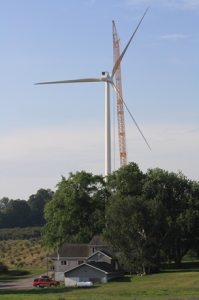
Figure 1-An industrial-scale wind turbine during installation near the Shineldecker home in Mason County, Michigan.

By Jerry Punch, PhD, and Richard James, INCE, BME

Cary Shineldecker was skeptical about the wind project the Mason County, Michigan, planning commission was considering for approval. His home, two miles from Lake Michigan, was located in an area where nighttime noise levels were around 25 dBA, with only occasional traffic and seasonal farmland noises. The rolling hills, woodlots, orchards, fields, and meadows surrounding his property contributed to its peaceful country setting. He voiced his skepticism about the wind turbines repeatedly in community meetings held beforeConsumers Energy was finally granted approval to construct 56, 476-foot, turbines that would place one turbine 1,139 feet from his property line (Figure 1), six within 3,000 feet, and 26 that are visible from his property.

He and his wife Karen started to suffer symptoms of ear pressure, severe headaches, anxiety, irritability, sleep disturbance, memory loss, fatigue, and depression immediately after the turbines began operating.

Continue reading Adverse Health Effects from Industrial Wind Turbines

Adverse Health Effects of Industrial Wind Turbines

wind turbine noise health

Adverse Health Effects of Industrial Wind Turbines  Jerry Punch PhD  Richard James INCE, BME

This article, the first of three installments, provides a broad overview of the topic. The second installment will review the major research findings linking low-frequency noise and infrasound from industrial wind turbines with effects on health and quality of life, and the third will discuss the relationship between various health effects and the processing of infrasound by the ear and brain.[1]

Cary Shineldecker was skeptical about the wind project the Mason County, Michigan, planning commission was considering for approval. His home, two miles from Lake Michigan, was located in an area where nighttime noise levels were around 25 dBA, with only occasional traffic and seasonal farmland noises. The rolling hills, woodlots, orchards, fields, and meadows surrounding his property contributed to its peaceful country setting. He voiced his skepticism about the wind turbines repeatedly in community meetings held beforeConsumers Energy was finally granted approval to construct 56, 476-foot, turbines that would place one turbine 1,139 feet from his property line (Figure 1), six within 3,000 feet, and 26 that are visible from his property.

He and his wife Karen started to suffer symptoms of ear pressure, severe headaches, anxiety, irritability, sleep disturbance, memory loss, fatigue, and depression immediately after the turbines began operating.

Gradually, as sleep disturbance turned into sleep deprivation, they felt their home was being transformed from a sanctuary to a prison. Deciding to sell their home of 20 years, they put it on the market in March 2011, and it has remained unsold for 3-1/2 years. For the past 1-1/2 years, their nightly ritual is taking sleeping medications and retreating into their basement to try to sleep on a corner mattress. They received few offers to buy their home, and recently accepted an offer that would mean a substantial financial loss. They are scheduled to go to trial against Consumers Energy, and if their case goes to settlement without a trial, they will likely be forced into a confidentiality agreement about their case.

Similar complaints of adverse health effects (AHEs) associated with living near utility-scale wind turbines have become commonplace in the U.S. and other developed countries. Energy companies in the U.S., motivated by lucrative tax subsidies available for developing wind resources as a form of green energy, are pushing aggressively to install more wind turbines, typically locating them near residential properties. Many rural residents now have one or more industrial machines that stand over 40 stories tall on the property alongside their home. Complaints about noise from people living within the footprint of wind energy projects are very similar to those experienced by the Shineldeckers.

Those who have never visited a wind project or who visit one only during the daytime often leave believing that the complaints of noise are unfounded, and commonly assume them to be psychologically motivated or a form of NIMBYism [1]. Those living near wind turbines say that unless one is willing to spend several nights in the area they have not experienced the noise that causes the complaints.

Article can be read here.