Category Archives: harm to wildlife

Debate Continues Over Wind Energy

CHCH News

Wind is fairly new and controversial in this province with some saying it’s a much needed clean source of energy, while others — many of them in communities around Lake Ontario and Lake Erie — are saying ‘not in my backyard’. Considerations with wind turbines include the environmental mark they make and the environmental benefits they offer, as well as the financial implications.

There are five wind turbines in West Lincoln now but there will be many, many more as soon as they pass environmental approvals. Ontario Power Authority says wind is an important part of its energy portfolio — it’s expanding infrastructure for all the power Ontario produces and the province wants a mix of sources so they balance each other out — especially now that they’ve phased out coal. But in West Lincoln, people say their rural way of life is being destroyed, and there’s nothing they can do to stop it.

The wind turbines in West Lincoln don’t seem to make noise, but Zlata Zoretic has lived in their flickering shadow since they went up a year ago: “Just whomp, whomp all day. It’s terrible.”

The sound is on YouTube. People living near wind turbines complain of headaches, inability to sleep, ear ringing and diminished property values. Nellie Dehaans is terrified of this. For decades, she’s lived on the other side of Smithville: “It’s going to look much different. I’ve got turbines coming that way, that way, that way. West Lincoln’s getting 44, the whole project is 77 plus three extras in case.”

The wind farms are expected to stretch from Smithville to Wainfleet. And the turbines will be much bigger — the size of a 60 storey building.

Wind power can cost almost twice as much per kilowatt hour as gas or nuclear energy. But there’s no power when there’s no wind — like in a muggy summer heat wave.

Wendy Veldman lives next to a turbine: “They produce it when we need it the least. They are not reliable. The wind is blowing today. But, there are some days when they sit still. What are we going to do when that’s happening. But, there always has to be backup power.”

If there is too much wind, the power has to be sold off at a loss, or the companies are paid not to produce. But, we don’t pay when there’s no wind.  Read rest of article here.

Watch local windwarriors being interviewed here. http://www.chch.com/wp-content/plugins/projekktorvm/embed.php?id=15253&poster=http://www.chch.com/wp-content/uploads/2014/09/2014-0924-WindEnergyEN6.jpg&long=&noad=false#rdzutabx
Ostrander Point unveils a Pleasant Surprise over the Weekend!

Press Release – August 12, 2014 – PECFN’s first Bio Blitz a resounding success

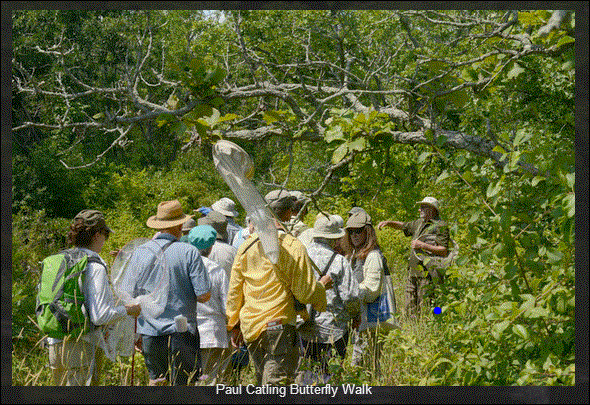
buterfly walkPicton:  Ostrander Point was swarming with nature lovers on the weekend.  Over sixty individuals helped PECFN collect information about animals, birds, plants, insects, amphibians and reptiles on the Crown Land Block.  Tanya Pulfer Ontario Nature’s Reptile and Amphibian Atlas coordinator joined Dr. Paul Catling, alvar specialist, Ted Cheskey Manager of Avian Conservation at Nature Canada and local renowned naturalist Terry Sprague to lead participants on hikes throughout Ostrander Point enumerating everything they saw. Expert witness evidence at the ERT hearing in winter/spring 2013 convinced the panel that a proposed nine turbine wind power project should not be built at Ostrander Point.  However, after an appeal by the Ministry of the Environment and Gilead Power, the Divisional court overturned that decision. Now PECFN is back at court, this time at the Court of Appeal challenging the Divisional Court decision.

CaptureWhile the Blanding’s turtles were well concealed in cool mud, Monarch and Giant Swallowtail butterflies were making good use of the wild flower meadows.  Several Monarch caterpillars were found on the plentiful milkweed.  An exciting new discovery for Ostrander Point was the Harvester Butterfly, the caterpillars of which feed only on a particular group of plant lice, which in turn feed only on a few kinds of woody shrubs in swamps. It is our only carnivorous butterfly. This remarkable, rare and local insect is not only new for Ostrander Point; it is also the first and only record for PEC, again establishing the biodiversity value of Ostrander.  Also documented was the rare Appalachian Brown Butterfly also an inhabitant of swamps.

Later under the full moon, five Whip-poor-wills were heard and spotted feasting on the wing probably eating the Dobson flies which were recorded as occurring in the bur oak savannah and acknowledged as a major food source for these birds. During the day, several Black -billed Cuckoos were heard calling, one of which reacted to a call lure by dive -bombing Terry Sprague!

Long Run Imports on County Rd 13 was established as base camp for registration, information, schedules, water and food.  The main site camp was on Ostrander Point Rd. allowing participants to explore into the alvar, meadow, forest and wetland areas. Helmer Rd was also used for morning bird walks.

Now the work of tallying the results begins but everyone agreed that this was a successful weekend and valuable data was gathered. The data will allow us to answer some of the questions about Ostrander Point that have been left unanswered by the studies done by the Ministry of Natural Resources and Gilead Power.  It will be added to the County’s Natural Heritage System data base and help to inform the Official Plan Review on the environment of the South Shore.

Information: Cheryl Anderson 613-471-1096 cherylanderson23@sympatico.ca

Myrna Wood 613-476-1506 myrna@kos.net

via: Save Ostrander Point

PECFN Files for leave to Appeal Divisional Court Ruling

PECFN Files for leave to Appeal Divisional Court Ruling

For immediate Release

Picton: PECFN has filed their submission to the Court of Appeal asking for leave to appeal the Divisional Court reversal of the decision of the Environmental Review Tribunal.  Last July the Tribunal revoked the approval of a Gilead Power wind turbine project at Ostrander Point Crown Land Block in the centre of the Prince Edward County South Shore Important Bird Area. There have been more than 20 appeals of Renewable Energy Approvals since the Green Energy Act came into effect in 2009. All but the PECFN appeal resulted in dismissals. In allowing PECFN’s appeal, the Tribunal rendered a landmark and precedent-setting decision.


Soon after the Divisional Court decision Gilead Power announced its intention to start construction in April.  PECFN brought an urgent motion for a Stay of construction and leave to appeal the Divisional Court decision to the Court of Appeal.  In his decision submitted on March 25, Judge Blair of the Appeal Court held that he had “no hesitation in granting the Stay” because the issues raised on the proposed appeal are of “broad public implication in the field of environmental law”.  Further he found that the irreparable harm criterion had been satisfied on the basis that “once a habitat is destroyed, it is destroyed – for at least short-term purposes, in any event – and the species sought to be protected here is a vulnerable and endangered species.”


On April 4, the Divisional Court found that Gilead’s demand for $120,000 legal costs from PECFN was too high and lowered it to $40,000.  More importantly, the reason given is that “clearly the case is of important public interest”.  It is significant that two judges have based decisions on the importance of the case to the public interest.  “We see this as a positive indicator that permission to appeal will be given” commented, Myrna Wood, PECFN president.  “We will also be able to use this argument for an appeal against paying any legal costs to Gilead or the Ministry”.  “The notice of intention to seek leave to appeal has attracted increasing expressions of support for PECFN’s opposition to industrialization of the South Shore IBA. We believe that this important test of Ontario environmental law encourages other environmental and legal organizations to apply to intervene in the appeal.” Wood continued.


The struggle to save Ostrander Point has gained a broader dimension since two other wind turbine projects in the area have been submitted to the government Registry (EBR) for public comment.  The White Pines proposal includes 29 turbines spread across private lands within the IBA surrounding Ostrander Point.  Windlectric Inc. proposes 36 turbines spread across the Amherst Island’s natural areas.  Residents of Amherst Island have applied to the Superior Court of Justice in Toronto for a judicial review of the Ministry of Environment’s announcement that the project is deemed complete.  They challenge the company’s claims that their plan has mitigated any harmful effects to wildlife and people prior to construction.

The cumulative effect of proposed turbine projects surrounding eastern Lake Ontario creating a barrier across the eastern flyway of migrating birds and bats is a concern for all naturalists.  If approved, these projects will displace wildlife from shorelines, the most important staging and resting habitats for many species.  Renewable energy will not be ‘green’ if it destroys significant wildlife habitats.  Recognition of this fact is demonstrated by two recent project cancelations. British Petroleum has cancelled a project on Cape Vincent across from Wolfe Island.  On the Lake Erie Pelee flyway two proposed projects in Ohio have been cancelled due to the threat of a lawsuit by Black Swamp Bird Observatory and the American Bird Conservancy.


The Appeal Court’s decision on our request to appeal may not be made until June.  In May, everyone will be enjoying one more spring migration and searching for emerging Blanding’s turtles along the South Shore firmly resolved to continue in the struggle to Save Ostrander Point.

-30-

For more information: Cheryl Anderson 613-471-1096cherylanderson23@sympatico.ca
Cheryl Anderson

28 Low St., Picton ON K0K 2T0

613-471-1096

613-849-7743 (cell)

@saveostranderpt

www.saveostranderpoint.org

Sad news Ostrander Point ERT Appeal Decision revoked by divisional court

Court favours wind turbines over Blanding’s turtle

An Ontario court has ruled that an environmental tribunal erred when it rejected a proposed wind farm that threatens the habitat of Blanding’s turtles.

By John Spears Toronto Star

Blanding’s turtle is in trouble again: An Ontario court has cleared the way for a wind farm that an environmental tribunal says will threaten the turtle’s habitat.

The modest reptile had stood in the way of a wind farm at Ostrander Point in Prince Edward County.

But a divisional court panel ruled Thursday that the environmental tribunal made six errors of law in reaching its conclusion that the wind farm would cause “serious and irreversible harm” to the turtle.

The court restored the decision by provincial officials, allowing Gilead Power to proceed with the project, which would erect nine big wind turbines on the site.

It was a bitter blow to local nature and conservation groups. They had argued the wind farm – and the increased traffic associated with it – would harm not just the turtles, but also birds, bats and the rare “alvar” ecosystem at Ostrander Point.

The court sided with Gilead.  Read rest of article.

Divisional Court January 22, 2014- Going Down a Rabbit Hole

Cheryl Anderson

Interested observers continued to give up their personal time to attend the Divisional Court hearing today.  About 40 people attended.  It is wonderful how many people have been willing to come from the County in the middle of the week to support PECFN.

Sitting in the Court one begins to wonder about the whole process.  PECFN is here to defend the decision of the Environmental Review Tribunal.  The Tribunal is not in Court.  The Ministry of Natural Resources is not in Court and yet the decision of that ministry to allow species at risk to be killed, harmed or harassed at Ostrander Point is being discussed at length.  The Tribunal was a creature of the MOE and yet the MOE trying to prove that the Tribunal made the wrong decision.  Shouldn’t the MOE be supporting its own creation?  Myrna asks “Are we going down the rabbit hole here?”

The Gilead and Ministry of Environment lawyers spent the morning discussing whether the Environmental Review Tribunal’s decision was in conflict with the Environmental Protection Act and why there was no evidence given about the numbers of Blanding’s turtles at Ostrander Point, the amount of vehicular traffic or the potential increase in vehicular traffic if the project is approved.  Throughout, the 9 turbine Industrial Wind Turbine project at Ostrander Point was described as a” Public Infrastructure Project”.  As you can imagine, this description made the majority of the observers gag!  The next topic was the suggestion that the Tribunal should have considered alternatives to the project – i.e. made a provision that the roads be closed to the public and offered to approve the project with that condition.   Again there was protracted discussion about the relationship between the ERT and the ESA permit issued by the MNR.

Eric Gillespie spent the afternoon responding to the arguments of the MOE and Gilead.  At this juncture we have to say a very special “Thank you” to Natalie Smith.  Natalie spent the fall analysing the ERT decision and preparing for the counter appeal by Gilead and the MOE.  She has been at Eric’s side throughout and provides the extra knowledge to make sure that we are successful in defending the appeal.

Justice Nordheim put a little wrinkle in the proceedings when he asked Eric to show him where in the ERT analysed the difference between “serious” and “irreversible”.  He wanted to be able to follow the ERT’s reasons for coming to the decision that the Gilead project would cause irreversible damage to the Blanding’s Turtles at Ostrander Point.  Of course, Eric and Natalie were able to find several instances in the decision that showed the analysis of the ERT and how they came to the decision to turn down the Gilead project.

The appeal continues tomorrow morning at 9:30.  The APPEC appeal is scheduled for Thursday afternoon.  I will report on the final few hours of the PECFN appeal tomorrow evening when I get back to the County.

Thank you to everyone for your continued support and for the encouraging messages.
Cheryl Anderson

Birds and wind turbines at a crossroads

Written by Donna Lueke –   Beacon News, Dec. 3 2013

Two environmental issues are at a crossroads here on the shores of Lake Erie. Two of our most prominent natural resources seem to be on a collision course.

Birds and birders flock to the shores of Lake Erie. There is more of a concentration of bald eagle nests here than anywhere in the United States except Alaska. The Atlantic and Mississippi Flyways converge near here. Each spring this area is the home of the largest birding event in the country, The Biggest Week in American Birding, which last year helped attract more than 70,000 birders from all over the world. Economic impact studies conducted by Black Swamp Bird Observatory (BSBO) and Bowling Green State University show that visiting birders spend more than 30 million dollars in the local area each spring. The internationally renowned Kaufman Birding Guides and the Black Swamp Bird Observatory (BSBO) have made Ottawa County their home.

Energy costs are high in Ottawa County. Here where the water meets the shore, the winds are frequent and strong. Wind turbines are being constructed at schools and private industries all over the area. As a green, clean, renewable alternative to the fossil-fuel-fired plants, wind power is becoming a popular choice. Yet, even with government subsidies, wind power is still an expensive alternative form of energy. The other significant negative with wind power is that birds, especially songbirds, eagles and other raptors, can be killed by wind turbines.

Read rest of article here.

Wind Power Is Brought to Justice -Wall Street Journal

By Robert Bryce  November 28,2013
The Justice Department announced late last week that a subsidiary of Duke Energy  has agreed to pay $1 million for killing golden eagles and other federally protected birds at two of the company’s wind projects in Wyoming. The guilty plea was a long-overdue victory for the rule of law and a sign that green energy might be going out of vogue.As Justice noted in its news release, this is the first time a case has been brought against a wind company for violating the Migratory Bird Treaty Act. The 1918 law makes it a federal crime to kill any bird of more than 1,000 different species. Over the past few decades, federal authorities have brought hundreds of cases against oil and gas companies for killing birds, while the wind industry has enjoyed a de facto exemption. By bringing criminal charges against Duke for killing 14 golden eagles and 149 other protected birds, Justice has ended the legal double standard on enforcement.

While it is heartening to see the Obama administration finally following the law, Justice’s decision might also indicate that the green bubble is about to burst.

                         cat

Consider data from the American Wind Energy Association, an industry group. In 2012, when federal subsidies were flowing, wind companies installed a record 13,131 megawatts of new capacity—about 6,500 turbines. But installations have tanked this year amid uncertainty over the extension of the federal production tax credit, which offers companies a hefty 2.3 cent per kilowatt-hour subsidy. During the first three quarters of 2013, the domestic wind industry installed a mere 70.6 megawatts of new capacity. Wind-industry lobbyists are desperately trying to get the production tax credit extended again before it expires at the end of the year. The Duke case won’t endear them to the public.

The renewable-energy craze may also lose its lustre as the public discovers how expensive “green jobs” are. Texas is the top wind-energy state in the nation. But in January Texas Comptroller Susan Combs  reported that each wind-related job in the Lone Star State is costing taxpayers $1.75 million.

There is also a public backlash against ruining scenic countryside with giant wind turbines. The outrage spans from the United Kingdom to Wisconsin. Last year, to cite just one example, about five dozen landowners in Herkimer County, New York filed a lawsuit against the owners of the Hardscrabble Wind Power Project. Their many complaints included reduced property values and excessive noise. To judge from news reports, suburban and rural residents don’t want 130-meter-tall windmills in their neighborhoods. They also don’t want the constant noise the turbines produce, or the relentless blink of the turbines’ red lights all night, every night.

Definitive proof that the green energy bubble has burst will come when the government brings more legal action against renewable companies for violating U.S. law. That may be happening: The Fish and Wildlife Service has 18 active investigations into bird kills at various wind-energy projects. Seven have been referred to Justice for prosecution.

And it may not be limited to wind energy. Last week, Chris Clarke  of the California public television station KCET reported that the Ivanpah Solar Electric Generating System, a new solar-thermal plant in the Mojave Desert, killed 52 birds in October. Many of the birds were apparently killed by the intense heat generated by the project’s mirrors. It appears that the project is attracting birds, which means the deaths may increase when the facility reaches capacity. Mr. Clarke went on to opine that the solar-thermal projects now being built in the California desert “could well depress bird populations from the Arctic to the Panama Canal.”

Apologists for wind and solar power insist that wind turbines only kill a few birds while climate change is the real threat. Last month, in a letter to The Wall Street Journal, an official from the American Wind Energy Association said that wind energy “enables the U.S. to develop a diverse energy portfolio better equipped to fight climate change—the number one threat to wildlife, according to the U.S. Fish and Wildlife Service.”

Perhaps that’s true. But everyone is threatened when the law is not applied equally, and so the Justice Department should continue ruffling the feathers of lawbreakers in the green-energy business.


Threat of bat fatalities stalls Maine wind project

By RACHEL OHM Morning Sentinel

BINGHAM — The review of a proposed 62-turbine wind farm project in this Somerset County town has been put on hold in part because of concerns about  the danger the turbines might pose to bats being threatened by white-nose syndrome, a rapidly spreading fungal disease.

Little brown bats (pictured here) and northern long-eared bats are currently being evaluated for listing under the Maine Endangered Species Act and also the U.S. Endangered Species Act.

There is no estimated date for when the Bingham wind project might be approved by the Maine Department of Environmental Protection, Dan Courtemanch, project manager for the agency’s Division of Land Resource Regulation, said Monday. A decision was originally expected this month, he said.

Read rest of article here.