Mother’s Against Wind Turbines Inc. (MAWTI), is calling for an immediate moratorium on the operations of current wind energy facilities in the province and the cessation of approvals of future projects. We have prepared the following brief which has been delivered to the Premier Doug Ford, as well as mailed to all MPP’s with a portfolio and a mailed copy was also sent to each MPP that is an assistant to a minister with a portfolio.
Please consider our document and distribute as you determine.
Opposition to wind power generation facilities placed in rural communities played a role in the June 2018 election for Provincial Government
Ontario has elected a new Provincial Government and what lies ahead for the energy sector is sure to be an interesting play of policy decisions based on election promises and market realities. Many opinions are being expressed as to what if will mean for contracts for renewable energy projects , including those powered by wind.
The link below outlines an analysis of what may lay ahead.
Premier Doug Ford ran and won on a platform labeled For the People: A Plan for Ontario. The platform set out Ford’s energy plan, in its entirety, as follows:
We will:
Clean up the Hydro Mess and fire the board of Hydro One and its $6-million-dollar CEO. Our first act will be to end the Liberal practice of making millionaires from your hydro bills!
Stop sweetheart deals by scrapping the Green Energy Act.
Cut hydro rates by 12% for families, farmers, and small businesses by:
Returning Hydro One dividend payments to families.
Stopping the Liberal practice of burying the price tag for conservation programs in your hydro bills and instead pay for these programs out of general government revenue.
Cancel energy contracts that are in the pre-construction phase and re-negotiate other energy contracts.
Declare a moratorium on new energy contracts.
Eliminate enormous salaries at Ontario Power Generation and Hydro One.
Stabilize industrial hydro rates through a package of aggressive reforms.
What this will cost:
Hydro One Dividend – $300-$400 million per year.
Moving Conservation Programs to Tax Base – $433 million per year.
Andrew Coyne: Liberals, keep your moralizing mitts off our Canada Pension Plan
McKenna’s tweet was just the usual non-stop, 24-hour moralizing we’ve come to expect from the primly ideological fanatics in this increasingly ridiculous government
It’s probably nothing. It was just a tweet, after all.
But when the federal environment minister, Catherine McKenna, posted her approval of a recent Canada Pension Plan Investment Board decision, it caused a little flutter of alarm among those who follow these things.
“Now, this is something that Canadians can be proud of,” she cheered, linking to a story about the CPPIB’s plans to invest more than $3 billion in green energy projects, “as it prepares for the global transition to a lower-carbon economy.”
Ministers of the Crown do not normally comment on CPP investment decisions, approvingly or otherwise, and with good reason. Though the federal and provincial governments set the broad terms of the plan’s operations — how much it collects in “contributions” from employers and employees, etc — the CPPIB, which is responsible for investing the $356 billion accumulated in the CPP Fund, is supposed to operate at arm’s length from all of them.
Now, this is something that Canadians can be proud of. The CPP
is planning to invest more than $3 billion in renewable energy as it prepares for the global transition to a lower-carbon economy. https://t.co/hsssiwYE47
Dear John [Fraser, interim Ontario Liberal leader],
Over the past four years we have written, faxed, emailed you and your previous fellow MPP’s many times and clearly told you one of the ways the Liberal party of Ontario was going wrong.
The Liberals’ callous, cruel disregard for the rights of the people of Ontario was very clearly demonstrated right up to the last week of parliament when over 3,000 people signed petitions simply asking your party to recognize your own lower, safer noise levels for industrial wind turbines. Late Friday, May 3 MOECC approved the Nation Rise Wind project using the higher noise levels (EDP Renewables of Portugal had surveyors on local roads Monday, May 6) and your party leader dissolved parliament May 7. The approval inflicted an additional debt on all people of Ontario of $1.8 million/month guaranteed for 20 years to a foreign county.
Over the years we asked you and your party, why? Why the damage to Amherst Island, the 20 wells in Chatham-Kent, the ignored noise complaints, the removal of rights of the municipalities and people of Ontario under the Green Energy Act?
John, your party has a lot to answer for including the anguish your party has inflicted. We sincerely hope you do not achieve official party status; a party such as yours that treated the people of Ontario as you did does not deserve to be anywhere near the democratic government of Ontario. Ruby and Joe Mekker
14117 Con. 1 – 2
Finch ON
The number-one challenge of our times is to separate the wheat from the chaff. To assist in this task, we are blessed with more information than ever before – but we are also simultaneously burdened with more misinformation than any prior generation has ever had to deal with. We look back and wonder how trusting citizens were so easily victimized by snake oil salesmen, but today, in the golden age of cons, we are being duped on a daily basis.
As a representative matter (and a national issue of great significance), let’s look at what’s happening with industrial wind energy.
The primary reason why wind energy has been a success has nothing to do with wind energy! Instead, its success is 100% due to the fact that wind energy proponents are masterful lobbyists. If one reads The Business of America Is Lobbying, it’s apparent that the wind industry has used every trick in the book, and then written some of its own.
For example: Wind lobbyists have successfully infiltrated our language with totally inaccurate and misleading terminology, such as “wind farms” and “clean energy.” Neither exists.
For example: Wind marketers have successfully portrayed their product as “Free, Clean, and Green” – despite it being none of those. The reason they have coined these malapropisms is simple: those who control the words control the narrative.
For example: Wind salespeople have successfully convinced financially distressed communities that hosting a wind project will be a economic windfall – even though numerous studies from independent experts indicate that the net local economic impact could well be negative.
For example: Wind-peddlers have successfully sold technically challenged local representatives that the wind-developer is their friend and business partner – even though these sophisticated and aggressive entrepreneurs typically look at these rural people as rubes and marks, and their number-one focus is to make as much money as possible, at the rubes’ expense.
For example: Wind developers have successfully persuaded much of the public that wind energy is an inevitable matter, so fighting it is a lost cause. The reality is that in many cases, local communities can effectively defend themselves by simply passing a proper wind ordinance.
For example: Wind-supporters have successfully imparted the belief that a certain wind project will power 20,000 homes – even though that project will not actually power a single home 24/7/365.
For example: Wind advocates employ a sleight-of-hand tactic to dismiss noise complaints by claiming that “wind turbines don’t make any more noise than a refrigerator.” The fact is that the main acoustical concern with wind turbines is the infrasound generated (which is below our level of hearing). So discussing the audible part of turbine noise purposefully distracts from the serious inaudible (but still very much experienced) noise issue.
For example: Wind propagandists say that wind energy is saving the environment – even though the evidence indicates that it is environmentally destructive on multiple fronts.
For example: Wind-promoters have successfully conveyed the idea that wind energy is a low-cost option of electricity – even though when all its costs are fully accounted for, wind energy can be three to five times as expensive as traditional electricity sources.
For example: Wind advocates have successfully communicated the notion that using more wind will directly result in the closure of coal plants – even though 10,000 wind turbines could never equal the performance of even a single coal facility.
For example: Wind-boosters have successfully disseminated the impression that wind is a major and essential contributor to preventing climate change – even though there is no empirical scientific proof that wind energy saves any consequential CO2.
For example: Wind champions have successfully relayed the conviction that the DoD Clearinghouse assures us that wind projects will not adversely affect the mission or operational readiness of our military or our national security – even though the DoD Clearinghouse was set up to accommodate wind energy (not the military), and the actual process is much more about promoting political correctness than protecting our national defense.
I could go on and on, as the list of wind lobbyists’ deceptions is distressingly long. That said, there is an additional major falsehood that needs to be exposed: that there is such a thing as wind energy by itself. This seemingly innocuous deceit is actually extraordinarily important.
The fact is that there is no such animal on the grid as wind energy by itself. What actually typically exists is a “Wind+Gas” package. This is mandated by the inescapable reality of wind energy’s unrelentingly unpredictable and uncontrollable output. No conventional source of electrical energy has these characteristics, so none need this special augmentation.
The importance of understanding this reality is that when we are talking about wind energy economics or environmental consequences, the only truthful analysis is objectively and comprehensively looking at the results of the Wind+Gas package.*
For example, it should be apparent that wind energy (i.e., the Wind+Gas package) is not a CO2 zero-emitter. In fact, due to other technicalities (never acknowledged by wind lobbyists) some studies have concluded that gas (combined cycle) by itself produces less CO2 than the Wind+Gas package.
Let me restate that extraordinary finding: gas can produce less CO2 than wind energy does!
Is the success of wind energy due to the sophistication of the con artists they’ve engaged or to our gullibility? In either case, the takeaway is that lobbyists are not reliable sources of information, especially when it involves significant money, our health, or our national security. The bottom line is that wind energy is palliative pabulum, not suitable for prime time.
Ontario’s Liberals lost official party status in the recent June 2018 vote for the provincial elections, under former Premier Wynne’s leadership. Energy policies and rising electricity rates were a hot button election issue.
Struck by a Hockey Puck: Renewable Energy’s Big Canadian Black Eye
Everybody loves renewable energy, right? That’s what surveys tell us with global support for renewable energy consistently polling above 80 percent.
But don’t tell that to the people of the Province of Ontario, Canada. On June 7, the electorate handed a stunning defeat to its Liberal Government after 15 years of reign. The election winner: Conservative Doug Ford, brother of Toronto’s infamous crack-cocaine smoking mayor, Rob Ford. The issue in the forefront of voters’ minds: sky high electricity prices.
Ever since the Ontario Government invoked its Green Energy Act in 2009 to transition away from coal power to wind and solar energy, electricity prices have risen a whopping 75 percent. In Ontario, electric bills have become as frequent a topic of water-cooler conversation as apartment rents are in Manhattan or San Francisco.
Without question, on every measure of ratepayer protection Ontario is an egregious case of how not to design a renewable energy program:
Most Feed-in-Tariff (FIT) rates set not by competitive bidding but instead by Government decree at levels as high as $C 80.2 cents ($US 62 cents) per kWh for 20 years
No mechanism to automatically adjust FIT rates downward as capacity deployment thresholds were reached
Domestic Content requirements that raised domestic equipment prices above global average selling prices
A rule that ratepayers still provide FIT payments for energy even when energy production is curtailed
An allowance of five years after FIT contract execution for facility construction, creating windfall gains for developers as equipment costs declined while preventing ratepayers from participating in any of those savings. How did Ontario get their renewables policy so wrong?
“The Green Energy Act is toast,” he added. “But the act is a very large, far-reaching piece legislation. It’s not just about some wind and solar generation. It has huge impacts on the administration of the electricity system.”
Post-election analysis: Five key local issues to watch
From deeply divisive wind energy projects, to school closings and transportation, five issues loomed large in the London region during the Ontario election.
GREEN ENERGY: ‘The pigs are not going to fly’
Randy Richmond
The London Free Press
Despite Doug Ford’s commitment to tear apart Ontario’s energy system, consumers shouldn’t expect to see much change in their electricity bills, says an energy analyst and researcher.
“Don’t expect your rates to go down. The overall cost of power is likely to rise over the next four years. The power system will look a lot like it does today,” Tom Adams said.
What will likely be gone: The Liberals’ $600-million conservation fund that paid homeowners for installing energy efficiency upgrades.
But even that won’t come without strong opposition, said Adams, author of several academic papers on energy and a consultant for consumer organizations.
Ford has promised to scrap the controversial Green Energy Act, the legislation that led to costly wind turbine projects across Southwestern Ontario – often over the objection of municipalities stripped of control over the location of energy projects.
The legislation became the flashpoint for anger over rising energy bills, which were caused only in part by sweetheart contracts with green energy suppliers.
Dutch fisherman take protest against offshore wind to Amsterdam
Fishermen take protest to Amsterdam
Published by FiskerForum, 03-06-2018 · info@fiskerforum.dk
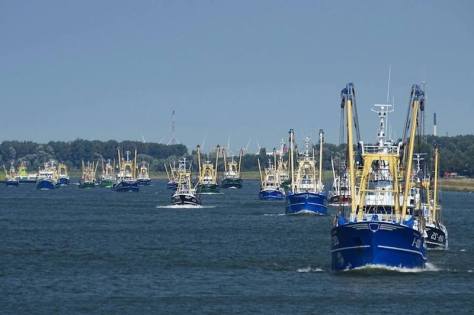
Hundreds of fishermen from Holland and Belgium took their grievances against the discard ban and the loss of fishing grounds due to the expansion of wind farms to Amsterdam this weekend, making plain their dissatisfaction with the way their industry is heading.
Seventeen fishing vessels docked in the centre of Amsterdam, a city that built its wealth and prosperity on the herring fishery. Between 600 and 700 fishermen from Holland and Belgium arrived in the city for a peaceful but highly visible protest that was followed by dozens of journalists.
The mothers and their children took a walk on May 27, 2013 protesting the Summerhaven Wind project that was under construction at the time. We marched together providing a record and demonstration of our non consent to the wind project. It also spiked a lot of interest from the Ontario Provincial Police and wind project security. The police decided they needed to be present with a marked police escort and their undercover members.
Mothers Against Wind Turbines remains firm in giving a thumbs down to industrial wind. We have not remained silent. We will not remain silent. No still means no.
On Saturday May 12, 2018 the second annual retreat was held at Silverdale Hall in West Lincoln, Ontario. Topic for the day long event was community action against the negative impacts of wind power. This gathering has quickly become our place to network, share information, meet old friends and make new ones. Under skilled guidance of Georgina Richardson the day built on work accomplished and explored paths going forward. Attendees worked hard reviewing and goal setting while developing and setting into motion action plans.
The battle remains about protecting our homes, families and communities from realized negative consequences due to wind powered generation facilities. The fight has brought together so many people who remain united and committed in seeking justice.








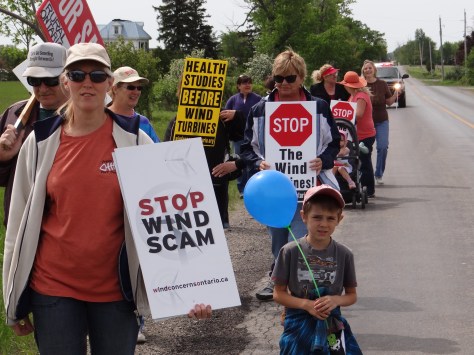 The mothers and their children took a walk on May 27, 2013 protesting the Summerhaven Wind project that was under construction at the time. We marched together providing a record and demonstration of our non consent to the wind project. It also spiked a lot of interest from the Ontario Provincial Police and wind project security. The police decided they needed to be present with a marked police escort and their undercover members.
 Mothers Against Wind Turbines Inc.