Credit: The Intelligencer | December 20, 2017 | ~~
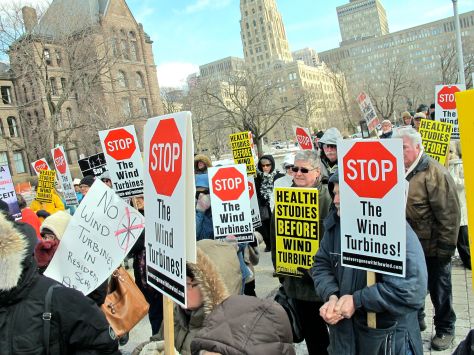
Experience is something you get right after you need it. On the heels of a potent, jam-packed rally in Milford to implore the government to pack up its turbines and go home, the bitter aftertaste and lingering sting of feeling deceived and betrayed remains ours to mourn and avenge.
When you think about it, the optics of investing in wind turbines can be construed as a patriotic opportunity to demonstrate support for green energy when better options may exist, but this turbine project is lead contender for first place as a blue ribbon colossal failure.
Clearly, Premier Wynne doesn’t want to be confused with facts, she has already made up her mind. Wynne is at the helm of The Ontario Green Energy Act – the largest transfer of wealth in Canadian history, and as it crosses the performance finish line, it’s lagging behind, Wynne thinks it came in first. As recited in quote after quote: The net result is this is the most over- priced, inefficient, redundant, useless subsidized wind power electricity in North America, never mind Ontario. All supply with no demand. Ontarians have an abundant supply of apologies and Mea Culpa’s from the Ontario Energy Minister for “sub- optimal outcomes”.
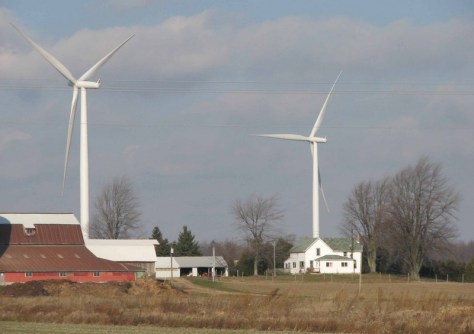
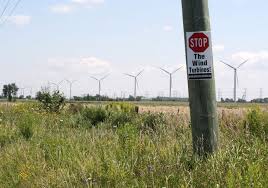
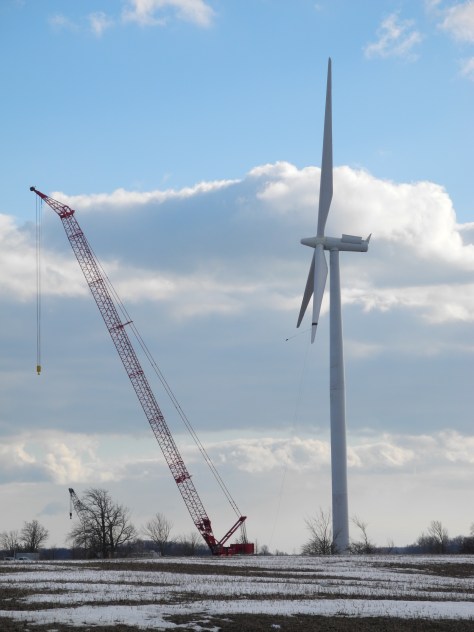
The notion of erecting seven 480’ turbines in Milford is just plain ludicrous, although the reality is easily heard by the heavy, gravel- laden trucks barreling down County Road 13 providing thunderous, early morning wake- up calls. The ugly esthetics beginning to sprout will impose a fire sale price tag for potential business investors in Milford and has struck fear in seniors inflicted with depressed residential land values while huddled beneath the looming white elephants. This is the Canadian government that has shoved its citizens to the sidelines to put up and shut up while they impose incompetent, environmental destruction upon a gentle community.
The knights of South Marysburgh tilting at wind turbines are growing in numbers scattered across the belly of South Bay in a mission to quash the project. Appointing Milford for monolithic wind turbines flies in the face of all that is naturally beautiful, peaceful and harmonious in the County. The 800- miles of shoreline tucked into warm, white sand dunes, tropically- hued waters, wine, food, farming, olive oil, maple syrup and bursting with artistic bounty is sacrilegious.
While defending both professional and personal scrutiny, perhaps Mayor Quaiff has the right idea, attacking the issue from within? After all, one of the most successful strategies every employed is “the enemy of my enemy is my friend”.
Milford owns the mouth’s that roar “we are mad as hell and won’t take it anymore” and it has fallen on the selected hearing of Wynne. Steve Ferguson closed his speech at the APEC annual general meeting last Sunday, quoting McGuinty “they (the public) can’t stay mad at us forever”. In Milford, Ontario, those are fighting words.
We were both astonished and upset to read the article printed on December 1st, accusing communities fighting wind turbine developments as being funded by the nuclear and fossil fuel industry. Nothing could be further from the truth!
We have seen first hand the struggle these communities face in raising the necessary funds to fight these industrial developments in the courts, through individual donations, taking out loans and organising community fundraisers.
It is the wind farm industry itself, which has become a ‘vested interest,’ relying on subsidies, grants and tax payer’s money. The recent report painstakingly researched by Wind Aware Ireland shows that the wind industry is costing us €1.2 billion annually as a nation.
In return for this, they have failed to significantly reduce our carbon emissions. It must also be realised that wind energy generates electricity, which accounts for only 20% of this country’s total carbon emissions.
Wind farms have become the easy option as the developers and investors are guaranteed profits through the Renewable Energy Feed-In Tariff (REFIT), which subsidises them and is paid for out of the PSO levy on each ESB bill. Central government has failed to do any cost-benefit analysis of the wind farm sector, to see if it is of any benefit to the country.
Meanwhile, rural communities have to stand up to these inappropriately-sited wind farm developments. Once they are built, they will provide no employment for the area and instead will reduce property values, keep tourists away and depopulate our countryside further.
There is also a growing body of evidence that ultra and infra sound generated by turbines have significant health effects on local residents. Most other countries have increased the regulations about the siting of wind farms, while in Ireland we are still subject to 10-year-old guidelines, made when turbines were one third of their present height.
Successive governments have promised to update these guidelines, but so far have failed to change them. We believe we have to look beyond the stranglehold of the wind lobby to other more effective ways of meeting our CO2 targets, including a mix of other renewables and a concerted effort to reduce our energy consumption.
Yours sincerely, Tony Miller & family,
Dunmanway. Ireland
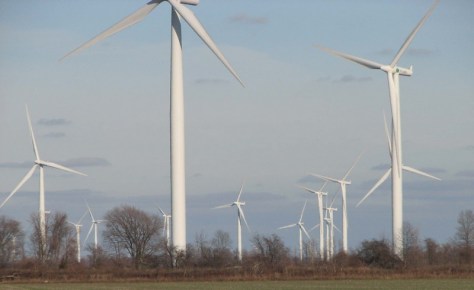
CHATHAM KENT ONTARIO ENBRIDGE WIND FROM HWY3 TALBOT TRAIL15
Kincardine Council asked the MOECC(Ministry of the Environment & Climate Change) on December 6, 2017 what is being done about continued noise reports at the Enbridge wind power project for the past NINE YEARS! MOECC District Manager documents the history of incomplete reports, and reported health effects.
TORONTO – Soaring power prices, wind farms imposed on places that don’t want them and now this: Ontario consumers being dinged by power companies for things such as raccoon traps, scuba gear and staff car washes.
Zapped before by the province’s spending watchdog for its handling of the energy file, Ontario’s Liberal government — heading into an election year — took it on the chin again Wednesday in Auditor General Bonnie Lysyk’s annual report, which found ratepayers have footed the bill for up to $260 million in ineligible expenses under a provincial program that puts the producers on standby to generate power.
She also found ratepayers are paying the cost for large industrial companies’ electricity savings, and that Ontario’s Independent Electricity System Operator (IESO) hasn’t implemented repeated recommendations from the Ontario Energy Board, including one that could save ratepayers $30 million a year.
Lysyk’s latest report looked at a program that pays power generators for fuel, maintenance and operating costs when the IESO puts them on standby to supply energy. Nine generators claimed up to $260 million in ineligible costs between 2006 and 2015, Lysyk said.
About two-thirds of that has been paid back.
One natural gas plant in Brampton “gamed” the system for about $100 million, the energy board, the province’s regulator, has reported.
Generators claimed thousands of dollars a year for staff car washes, carpet cleaning, road repairs, landscaping, scuba gear and raccoon traps, “which have nothing to do with running power equipment on standby,” Lysyk wrote.
One company claimed about $175,000 for coveralls and parkas over two years, she said.
“The program was such that bills could be submitted but without any support for the bills and the bills were being paid, and it wasn’t until more requests were made for detailed information that (the IESO) became aware that there were costs behind that bill that probably shouldn’t be reimbursed,” Lysyk said.
Lysyk had previously skewered the Liberals over electricity, concluding customers paid $37 billion for the government’s decisions to ignore its own planning process for new power projects, and that a $2-billion smart meter program spent double its projected costs and didn’t ensure conservation goals were met.
Her conclusions about the smart meter program led then-energy minister Bob Chiarelli to say the auditor’s numbers were less credible than his because the electricity system is complex and difficult to understand. Lysyk spent 10 years working at Manitoba Hydro.
The program to pay costs when energy suppliers are put on standby began in 2003, when Ontario’s electricity grid had supply issues, but now the province has surplus power.
When Premier Kathleen Wynne announced 14 months ago that her government was suspending Ontario’s renewable energy procurement process, she and her Liberal colleagues were caught in the middle of a public backlash against skyrocketing electricity bills. Halting a costly plan that promoted wind turbine farms was a quick, convenient response. Indeed, Wynne’s own energy minister admitted Ontario didn’t need the electricity that would be produced by new turbines.
But there was a problem. Six months earlier, several wind turbine projects had been approved, and the September announcement didn’t mean they would be cancelled. The contracts would be honoured. Ontario would be allowing the development of wind turbines to produce electricity that wasn’t needed.
Among those projects are two in Chatham-Kent and another in Elgin County. One has become an enormous public relations problem for the Wynne government, while the other two have the potential to become the same.
The first project is almost complete; but the others should be halted before they begin.
The North Kent 1 wind project was mired in controversy even before Wynne announced suspension of the renewable program. Construction activity is believed to have fouled or clogged at least 16 water wells because of interference to the area’s unique geology. Residents with damaged wells have made arrangements to have clean water trucked to their property.
The problems at the North Kent 1 project have stirred up fears a few kilometres away, at the Otter Creek project. Work has yet to begin, but residents are worried the same problems will affect their water. They’re also worried proposed turbine towers, the tallest in Canada, will be erected in an important migratory bird flight path.
Local MPP Monte McNaughton (PC — Lambton-Kent-Middleses) wants Otter Creek halted.
“These turbines are being built to generate electricity we don’t need, and they’re only going to contribute to driving hydro prices even higher,” he said.
In Elgin County, meanwhile, residents in Dutton Dunwich continue to campaign against a wind farm that has yet to be built.
Kathleen Wynne may have hoped rural Ontario’s long-held discontent with the Green Energy Plan would be forgotten by the June 2018 provincial election. But that’s not about to happen as the remnants of that multibillion-dollar campaign, and its varied controversies, continue to be revealed.
Lambton-Kent-Middlesex MPP Monte McNaughton delivered a bottle of turbid water to Environment Minister Chris Ballard in the Ontario legislature Tuesday to emphasize the impact wind turbine construction has had on area water wells.
We recently drove from London to St. Louis, Mo. On our drive to Windsor we saw many wind turbines. After crossing the border and driving through Michigan, Illinois, Indiana and Missouri, we saw no wind turbines.
I guess they do not need any, since we sell our electricity to them cheaper than it costs us to produce it.
The Alliance to Protect Prince Edward County (APPEC) has commenced legal proceedings naming the Independent Electricity System Operator (IESO) and WPD White Pines Wind Inc. (WPD) as respondents. APPEC alleges that the Feed-In-Tariff (FIT) contract between the IESO and WPD should have been terminated as soon as it became evident that WPD would be unable or incapable of fulfilling the FIT contract terms. These FIT contract terms have been made publicly available and are well known.
In 2010, a FIT contract for 60MW wind energy project to be operational within three (3) years was offered by the Ontario Power Authority (now the IESO) to WPD. The contract allowed for termination if the project was not able to deliver at least 75% of the contracted power. A Renewable Energy Approval (REA) was granted to WPD by the Ministry of the Environment and Climate Change (MOECC) five years later in 2015. Immediately after the MOECC approval, an appeal was made by APPEC to the Environmental Review Tribunal (ERT). In 2016 the ERT found that the project would cause serious and irreversible harm to the natural environment. After allowing the proponent an opportunity to propose additional mitigation measures to prevent this harm, the ERT still found it necessary to remove 18 of the 27 wind turbines from the project. As a result, the project is only permitted to erect nine (9) 2.05 MW turbines which can only fulfill approximately 30% of the original FIT contract requirement, far less than the 75% referred to under the contract.
APPEC has made an application to the Ontario Superior Court of Justice seeking a declaration that the FIT contract for the White Pines Wind Project is null and void and an injunction on any further work on the White Pines Wind project. A hearing on this matter is currently scheduled for November 17th, 2017 at 44 Union Street, Picton, Ontario K0K 2T0 at 10:00 a.m.
Kincardine council has decided to give it another shot, in support of some of its citizens.
At the October 4th council meeting, it was decided to send a letter to the Ontario Ministry of the Environment and Climate Change (MOECC) regarding citizens concerns about the effects of wind turbines near their homes.
The mayor says, “Our residents have gone through all the normal channels, sometimes a few times and the Ministry of Environment has answered some of them from time to time but they still have some outstanding concerns.”
Council was reacting to a letter written by Franklin and Deborah Walpole that states, “We are affected by the Enbridge project but we know that our neighbours living among the turbines of the Armow project have similar concerns.”
The letter suggests that both projects are “operating out of compliance.”
Eadie says it’s time for the municipality to “take it up a level” and demand some specific answers about the concerns of the residents.
She says obviously they would like sound audits to be done and the results to be reported.
The blowout of wind and solar in the Ontario Electricity System is revealed by production levels that are well below the rated installed capacity.
Ontario can produce power from nuclear, natural gas, hydro, wind, solar and biofuel energy generators. The results are recorded in many ways but the three used here are (A) the total installed capacity of each generator type (what was installed), (B) the forecast capability at outlook peak (what can be produced) and finally the (C) generator output by fuel type for 2017 (production).
According to the IESO report – 18 Month Outlook: An Assessment of the Reliability and Operability of the Ontario Electricity System from October 2017 to March 2019 – (http://www.ieso.ca/en/sector-participants/planning-and-forecasting/18-month-outlook ) Page 17 – Table 4.1 provides (A) total installed capacity and the (B) forecast capability @ outlook peak
It is neither possible nor desirable to run the electricity system flat out and some redundancy needs to be built into the system for maintenance and emergencies. The total installed capacity of all fuel types reported is 36,853 MW, but at peak demand the system is capable of producing 26,704 MW of power each hour. The total production that IESO counts on at peak demand is 26,704 / 36,853 = 72% of the energy system potential.
The second column provides the Forecast Capability at Outlook Peak and takes into account deratings, planned outages and “allowances for capability levels below rated installed capacity”. When you compare the installed nameplate capacity for wind and solar with the actual production there is an 80 to 90 % drop in production over nameplate capacity!
The total output for all fuel types (column C) for Jan – Aug 31, 2017 is available on the IESO website – ‘Generator Output by Fuel Type Monthly Report 2017’. The total output from Jan – Aug was 12,023 MW of power produced each hour. According to the IESO the forecast capability of the existing generator stations at outlook peak is 26,704 MW of power each hour. The production from the electricity system was 12,023/26,704 = 45% of the capability. So why did we agree to purchase power from Quebec?
The renewables – wind and solar are intermittent power sources and require back-up power. Natural gas was the choice made for Ontario. Natural gas is a responsive base load fuel that can be ramped up or down quickly. Nineteen natural gas plants have been commissioned in Ontario since 2003. According to the IESO they are capable of producing 8,371 MW of power each hour, yet the natural gas plants only produced 416.7 MW of power each hour from Jan – Aug. We have gas plants operating at 4.9 % of their potential!! This means that they are being under utilized and sit idle the majority of the time. The private for profit corporate owners are not running a charity so the Ontario ratepayers are paying millions of dollars each month to gas plants paid not to produce power.
Wind and solar on the other hand blew out. They were only able to produce 13.2 to 18% of their nameplate capacity. The production from wind for Jan – Aug 31 was 764 MW per hour from a name plate capacity of 4,213 MW. A dismal performance with 18% production from the installed nameplate capacity. According to the IESO the forecast capability for wind at peak demand is 533 MW or 12.7% of the installed capacity. The difference is explained as an “allowance for capability levels below rated installed capacity.” No kidding – considerable distortion exists in the presentation of material when a product has an 80% drop in production over the stated manufacturer nameplate capacity. This is like telling me that my new car is capable of 1000 km on a tank of gasoline and instead it goes 200 km!
According to the IESO the monthly wind capacity contribution values range from 12.6% to 37.8% of the installed capacity (18 – Month Outlook p.19). So the nameplate capacity of an industrial wind turbine is somewhat arbitrary.
To understand the limits of wind power, Glen Schleede explains it best. “Wind turbines have little or no ‘capacity value’ because they are unlikely to be producing electricity at the time of peak electricity demand. Therefore, wind turbines cannot substitute for conventional generating capacity responsible for providing reliable electricity to customers.
Second, a kilowatt-hour (kWh) of electricity from wind has less value than a kWh of electricity from a reliable (dispatchable) generating unit providing base load power – nuclear, natural gas or hydro which can produce electricity whenever the electricity is needed.
These issues are important because “wind farm” developers and lobbyists have misled the public, media and government officials by making false claims and by using terms intended to confuse their listeners
The true capacity value of a wind turbine or ‘wind farm’ is generally less than 10% of nameplate capacity and often 0% or slightly above — simply because, at the time of peak electricity demand, the wind isn’t blowing at a speed that will permit the turbine to produce any or much electricity. Claims of wind turbine capacity value have been exaggerated by wind industry officials and lobbyists, by regulatory agencies”, and as we are finding out in Ontario industrial wind turbines generate a minimal amount of electricity.
The IESO hourly wind generator output 2006 – the present provides data on every industrial wind facility in Ontario. If we use the West Lincoln NRWF industrial wind facility as an example we find that the facility is rated at 230 MW nameplated capacities. On average the facility produced less than 27 MW per hour during July, Aug and Sept of 2017, when electricity is generally at its greatest demand. The production was 11.7% of the name plated capacity! It never once reached its nameplate capacity of 230 MW and it only went above 200 MW for 20 hours in the last three months.
Hydro – a baseload renewable energy source – produced 3242 MW of power per hour from Jan – July from a potential of 5,786 MW. So we are only using 56% of the potential production from our cleanest, greenest, cheapest energy source. The sad reality for the ratepayers of Ontario is that the hydro plants could easily have been ramped up an additional 850 MW per hour to cover the contribution of wind and solar. Instead we ran the water over the dam.
Using nameplate capacity creates a false sense of the ability of renewables – wind and solar – to provide power. Wind and solar are both intermittent so we can not ramp them up or even depend on them for power because they only produce power when the wind is blowing or the sun is shining.
Consumers know they want the lights kept on, the refrigerator running and the industry rolling. But it is difficult for consumers to make informed decisions about the success or failure of a program when information is presented in such a convoluted manner. The renewable energy initiative in Ontario was a political decision. According to several reports from the Auditor General the Ontario government did not conduct a cost benefit analysis. To continue installing a power system that can not provide power on demand to cover up a bad decision will eventually lead to failure of the total electricity system and will be considered an act of betrayal by the ratepayers that are responsible for the bill.
To accommodate the wind industry, we are paying for hydro power generators to run inefficiently; we are paying for power generators not to produce; we are entering into contracts to purchase power when we are awash with over production and with the “Fair Hydro Plan” we are downloading $20 to $40 billion of debt onto our children and grandchildren.

 Credit: The Intelligencer | December 20, 2017 | ~~


 Mothers Against Wind Turbines Inc.