
Category Archives: Environment

Retired Ambassador Speaks Out

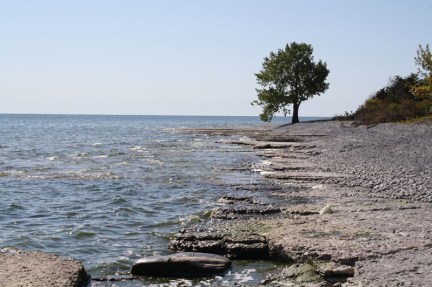
amherst-island-stone-walls-3-640x480
Amherst Island Heritage Stone Walls

john-schram

Dear Premier Wynne

Through 48 years of development and policy work – eleven of them as Canadian ambassador to several Africa countries, and the last eleven as adjunct professor at Carleton and Queen’s – I have been convinced that the world faces an environmental crisis. The last thing I could imagine myself doing was, and is, to speak out against Green Energy.

Instead, I was at the forefront of those sent abroad by Canada to encourage democracy, human rights, the rule of law, transparency in business and government – and protection of the environment.

Now I am at home, teaching what I have learned to graduate students, and living on Amherst Island near Kingston. Yet even here, the issues of governance, sound policy and the environment are at the forefront – and are often overlooked or misjudged in pursuit of political and financial goals.

Yes, Amherst Island faces a calamity of governance and environmental policy. Ontario government approval has been given for the Island to become a 26-turbine wind farm. On an island no longer than 20 km and 7 km wide, this massive installation is to be pressed through despite the strong opposition of expert naturalists, environmentalists and the majority of the island’s 450 residents – very few of whom (no one knows the number because the question has never been asked) – want to see this jewel of migratory birds, natural beauty and historic heritage destroyed by what is apparently a moneymaking scheme designed by generating companies to attract and exist on government subsidies. In our hitherto-close Island community, only the few who have succumbed to opaque, secretly-negotiated offers will benefit: in return for the proverbial mess of pottage, (we are told, less than $10,000 a year) they would destroy their own heritage and that of their neighbours by accepting wind turbines on their land.

Decisions have been made which could be understood in many of the African countries in which I have worked, but in the Canadian context, seem dramatically out of place and counter-productive. A money-making scheme has been dressed up as pursuit of a noble environmental goal; a fiercely committed but far from wealthy group of Islanders and friends are pitted against substantial corporations with incomparable legal and financial resources and the promise of tax-payer subsidies. The result of this uneven battle could indeed be the destruction of the very environment that green energy is designed to preserve.

All this would appear to leave the Island community and the Island at the mercy of a provincial process which in itself is unbalanced, if not faulty. Many studies and indeed judicial findings have suggested that Ontario has a surfeit of electricity; that taxpayers’ subsidies for green energy to produce yet more electricity are misguided; and that destruction of the environment through construction of new docks and roads, a cement plant next to the public school, heavy traffic loads which our lanes cannot bear, knocking down 150-year old dry stone walls and other heritage – all are being pursued over the strenuous objection of residents and despite evidence of clear and lasting harm to the very environment green energy is supposed to protect.

Thus, though green energy is essential, and environmental concerns must be pre-eminent, the pursuit of provincial political objectives through robbing Canadians and Ontario of a valuable natural assets requires forceful public comment – not only from those immediately affected, but from those who are making the decisions and allowing it to happen.

I am compelled to speak out. I hope you will join me.
John Schram
Amb (ret) John R Schram BA MA JD LLD
Senior Fellow, Norman Paterson School of International Affairs
Senior Fellow, Queen’s Centre for International and Defence Policy

About John Schram:

In his 36 years with the Department of Foreign Affairs, John Schram served in Nigeria and London, then worked actively in the South African struggle against apartheid and the transition to democracy. He was Director for Eastern and Southern Africa during the first South African elections and Canada’s participation in the Somalia UNITAF operation. From 1994 through 1998, he was high commissioner to Ghana and Sierra Leone and ambassador to Togo and Liberia; He was Canada’s ambassador to Ethiopia, Eritrea, Sudan and the Organization of African Unity from 1998 to 2002; and ambassador to Zimbabwe, Angola and Botswana from 2002 to 2005. He holds a law degree from the University of Toronto, and an MA in African Studies and honorary LLD from the University of Ghana. He now focuses on conflict resolution, peace building and development as Distinguished Senior Fellow with the Norman Paterson School of International Affairs at Carleton University, and the Queen’s Centre for International Relations at Queen’s University in Kingston.

Visit Association to Protect Amherst Island on Face Book: https://www.facebook.com/ProtectAmherstIsland/posts/1133135626735817:0#

Retired Prof Slams Handling of Wind Project :  http://www.thewhig.com/2016/11/02/retired-prof-slams-handling-of-wind-project?utm_source=addThis&utm_medium=addthis_button_facebook&utm_campaign=Retired+prof+slams+handling+of+wind+project+%7C+The+Kingston+Whig-Standard#.WBpkuHlr4FQ.facebook


Canadian Wind “Farms” deadly to thousands of bats

Canadian Wind Farms Kills Ten of Thousands of Bats

Wednesday October 5, 2016   |    

Hoary bats like this one are the species most often killed by wind turbines in Canada. ©Nessie Grace
A bat lies dead beneath a wind turbine in southern Ontario. ©Mike Anissimoff

Each wind turbine in Canada kills an average of 15.5 bats per year, adding up to a death toll that could someday threaten populations, according to new research. In Canada’s first comprehensive analysis of wind farm casualties, researchers found that turbines were killing about 47,000 bats per year in 2013. That number will only rise as Canada’s investment in wind energy increases.

“We have about 50 percent more turbines now, so, as of 2016, somewhere around 70,000 bats are being killed in Canada per year,” said Ryan Zimmerling, a wildlife biologist with the Canadian Wildlife Service and first author of a recent study in the Journal of Wildlife Management. “It is possible that those levels of mortality, if they’re not already causing impacts to some species now, could be causing impacts into the future.”

Wind energy companies in Canada are required to monitor bat mortality at newly built wind farms, regularly searching the area under turbines for carcasses. The companies report these data as part of post-construction monitoring, but until now, no one had combined them into a single nation-wide analysis. To see the big picture, Zimmerling and his colleagues analyzed carcass counts from 64 wind farms in nine provinces, using statistical corrections to estimate how many carcasses the surveyors missed.

Offshore Turbines in Great Lakes facing International Opposition

Plans to install wind turbines in the Great Lakes is facing international opposition by environmentalists and like minded organizations.  Globally significant flyways intersect and traverse the large lake systems which are located in North America. Wind development sites such as Wolfe Island in Ontario have documented high avian and bat mortalities due to wind turbines. Pressures of development are intensified with proposed multiple wind projects such as those in the Amherst Island area on Lake Ontario.  Next Era’s Summerhaven facility on the shores of Lake Erie has reported deaths of 24.99 bats per turbine in 2014. It is a widely held criticism that death rates are under reported as they are generated by the wind developers.  READ: http://www.nexteraenergycanada.com/pdf/summerhaven/BirdBatMonitoring/Summerhaven_2014_BirdBatMonitoringSummary.pdf

The threat of imminent extinction of several bat species in North America due to white nose syndrome ( a deadly spreading fungal infection) combined with high mortality rates arising from turbine operations is raising alarms world wide.  The Great Lakes still supports a strong commercial and sports fishery. The impacts of wind power to fresh water species remains a large unknown.  It is never too late to do the right thing.  Wind generation complexes do not belong in such sensitive habitats.

Offshore wind plan in Lake Erie criticized internationally

By John Miner, The London Free Press

lake-erie-ice

The fight to keep industrial wind turbines out of Lake Erie has become an international effort.

Environmental groups from Spain, France and the United Kingdom have now joined North American organizations in opposing a plan to build a pilot wind farm in western Lake Erie, near the Ohio shore, along the U.S. side of the border.

“I really feel there is a good chance of stopping it. Public outrage can do this,” said Sherri Lange, chief executive of North American Platform Against Wind Power, a Toronto-based coalition opposing wind farm development.

Known as the Icebreaker Project, the wind farm proposed for Lake Erie near Cleveland would involve the installation of six turbines to test the feasibility of building larger wind farms in the lake. It would be the first industrial wind farm in a fresh water lake in North America.

Ontario, meanwhile, has kept a moratorium slapped in place on offshore wind farms in the Great Lakes along its borders with the waterways.

Proponents have described Lake Erie as the Saudi Arabia of wind energy, with the potential for more than 1,000 wind turbines.

But the project has sparked intense opposition from a broad range of environmental groups who say the offshore turbines will disrupt migration routes for birds and bats, damage marine life and pose a pollution hazard.

Lange said she and others thought the Icebreaker Project had been defeated in 2014 after U.S. state officials cited a string of deficiencies, but then the project was given a $40-million grant earlier this year by the U.S. Department of Energy.

David Karpinski, vice president of operations for Leedco, the wind farm developer, said the project is continuing to move forward to gain the necessary government approvals.

“We are continuing to build momentum,” he said. “The detailed engineering is completed and we are moving into the commercial relationships for contractors to source and build what we need here.”

The current plan is to start construction the summer of 2018, Karpinski said.

Last week, the Ontario government said it has no plans to lift its moratorium on Great Lakes wind-farm development that had been imposed five years ago.

Industrial wind farms, with their highrise-sized turbines, have been deeply polarizing in Ontario, especially in the province’s southwest that is home to the largest wind farms and the most number of turbines. Some communities have declared themselves “unwilling hosts” for the projects, which Ontario’s Liberal government embraced with its green-energy law in 2009 as it took away local control over where the projects can be built.

Announced in the run-up to a provincial election, the Ontario government originally justified its moratorium on offshore wind development on the grounds there wasn’t enough scientific information on the potential impact of the turbines in the lakes.

jminer@postmedia.com

twitter.com/JohnatLFPress

wolfe-island
Wolfe Island- One of the highest recorded site for avian and bat deaths due to wind turbines in North America

READ ARTICLE AT: http://www.lfpress.com/2016/10/23/offshore-wind-plan-in-lake-erie-criticized-internationally

Bad Actors

“How did we get here? How did the people of Ontario become the enemy of the state?”

ostrander-point-ert-1

Posted: October 21, 2016 at 8:49 am   /   by

The image remains seared into the consciousness of everyone who witnessed the grotesque spectacle. The full power and fury of the state and its legal might, side by side with one of most powerful law firms in Canada, arrayed against the grey-haired volunteers of the Prince Edward County Field Naturalists. Five Goliaths against one David.

One side funded by taxpayers and corporate interests, the other by donations and the kindness of individuals in this community. One side working to forestall the demise of species at risk, the other side hungrily pursuing profits. Alongside them were government lawyers dispatched from Toronto to defeat the County’s Field Naturalists.ostrander-point-shore

How did we get here? How did the people of Ontario become the enemy of the state?

At a moment in history when liberal democracy looks more fragile than it has done in 70 years, the troubles infecting this province may seem trivial by comparison. It isn’t trivial to the folks of PECFN still working to pay their legal bill. Nor to the folks still battling yet another powerful developer and an unrepentant province in South Marysburgh. Or on Amherst Island.

Yet it is only by understanding how and why governments turn against their people that we see the roots of unrest and decay in democracy. A goodly portion of Americans who despise Donald Trump will vote for him next month, not because they believe he is a better candidate than his opponent, but because they want to throw a brick through the window of a government they believe is working against their interests.

To be clear, this isn’t a defence of their choices, but rather a caution that we are not immune to the illness that has infected American politics in this cycle.

I expect most of the handful of folks who volunteer with PECFN would not describe themselves as political. Their interests lie mostly in the natural world and the beasts that populate it. PECFN didn’t set out do battle with a provincial government indifferent to the plight of its own endangered species, or with a corporation determined to reap profits from industrializing the County’s south shore. They were thrust into this fight because the provincial government shredded its own protections and safeguards to give corporate interests free rein.

But why? What drives elected officials to use the state’s power and resources against those working to protect the natural world it has abandoned?

We got a glimpse last week when Kathleen Wynne defended her government’s cap and trade emmissions scheme. She told a business audience in Niagara Falls that Ontarians are “very bad actors” in terms of per capita emissions of greenhouse gases. It wasn’t a slip of the tongue—or offhand remark. These words were part of a scripted speech.

Fortunately for the wretched folks in this province, we have a premier who understands good and bad—better than we do. She has unveiled the selfish and narrow view through which we see the world around us. Kathleen Wynne will be our better selves.

In this morality play your provincial government has decided it will not work in your interest— but rather what it believes your interest ought to be. It knows this better than you. Kathleen Wynne, and Dalton McGuinty before her, believe they know what is best, and cling to the hope that history will judge them better than Ontario’s weak and myopic voters do now.

Maybe.

But untethered by accountability to its voters and deaf to its ministries’ advice and counsel, provincial Liberals have made a terrible mess of the energy supply system in Ontario. It will take decades to fix. It has squandered billions of dollars chasing schemes unworthy of a Nigerian postmark. It has pushed manufacturing jobs out of the province. And it has rendered electricity bills that are unaffordable for many of its poorest rural residents. Meanwhile, it has made a select group of developers very, very wealthy.

In turn, they have dutifully filled her parties’ coffers— to arm her for the next election.

How is it that the most righteous tend to be the most susceptible to corruption and misdeeds? There is something distinctly Shakespearean in this tragedy.

In 2011, facing an election Energy Minister Brad Duguid announced a moratorium on offshore wind development. Loud opposition was building in Duguid’s own riding at the prospect of industrial wind turbines rising just offshore from the Scarborough Bluffs. The science was unsettled, he said. But it was politics pure and simple. Duguid and the Liberals won the election. This week, taxpayers of this province learned the cost of his calculation.

This is because Duguid’s decision also scuttled a project to build offshore wind turbines near Wolfe Island by American developer Windstream Energy. The company sued. Last week ,a court awarded the company $25 million plus its legal expenses of nearly $3 million. Ontario taxpayers are on the hook for this bill. Furthermore, the developer maintains that its 300 MW contract, worth $5.2 billion, is still in effect.

It is the largest award ever ordered under the North American Free Trade Agreement—yet it is just the most recent cheque written by this government for power that will not be generated.

Ontarians have, indeed, been very bad actors.

RICK@WELLINGTONTIMES.CA

Join PEPTBO for their Fall Dinner on October 29 at the Waring House Inn Banquet Hall. Noted ornithologist Jean Iron will be the keynote speaker. For more information visit peptbo.ca or call the Waring House at 613- 476-7492 ext. 4220.

READ AT: http://wellingtontimes.ca/bad-actors/

Scant disclosure on wind turbine bird mortality

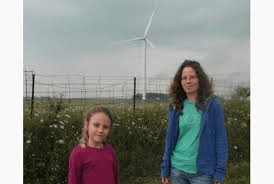
esther-and-daughterDear Editor

I just read “What’s a few chopped up birds” (From The Top of the Pile, Sept. 22) on wind turbines and bird deaths in Alberta and Saskatchewan. Way to go Saskatchewan for actually taking this issue seriously. We’ve never had this happen in Ontario!

I’m from southwestern Ontario, but moved to New Brunswick two years ago when the turbines went up. For six years I fought them, went to tribunal hearings, videotaped the scummy company Nextera destroying an active eagle nest, got sued by the same company because I parodied their logo as NexTerror and organized and attended uncountable protests during that time. If I would have stayed, remained surrounded by turbines, the kids’ school surrounded by turbines, I would have continued, but our health came first and we left the land I was born and raised on.

I’ve since realized the wind companies are killing way more birds and bats than the media or researches know, with impunity. The last report on bird/bat mortality that any wind developer released to the public was in 2012 (Transalta’s Wofle Island), then all of a sudden the whole industry stopped releasing these reports. I couldn’t find them anywhere.

Bird Studies Canada wouldn’t release the documents. They are confidentially working with the wind companies, on a voluntary basis. I asked the wind company Nextera for it. They told me they could give me a two-page summary in a couple months.

Other avenues were also blind alleys calling for freedom of information requests for what should be public documents.

After many months, and a faked ‘appeal’ by the wind company to delay the release, they came. My heart sank and my blood boiled. In six months the two local Nextera projects killed eight red-tailed hawks and 14 vultures. You can imagine what the raptor population will be in that area when the 20-year lifespan of this project is over. We lived on flat, prairie-like farmland, with small woodlots, good raptor habitat. But not now that there are more than 200 wind turbines there.

I decided to file freedom of information requests for all the wind projects in Ontario. There are more than 110 projects. I had to source out and make a comprehensive list and then presented it to the FOI office and the Renewable Energy co-ordinator for the MNRF. You know what the Ministry of Natural Resources and Forestry guy said? “I didn’t even know about half of these projects.” This is the guy in charge of wind turbines and wildlife in the province, and he doesn’t even have a list of the wind projects there? I asked them if they are studying the massive cumulative impacts these projects will be having on the bird and bat populations. His answer was no, not unless there is some secret study going on. So nobody is looking into it. Not a soul. It’s all eyes closed to these massive killers.

They told me it will probably costs me thousands of dollars to retrieve these documents through the FOI. I took a breath and said, “Do it.” I’ll set up a Go Fund Me, or something. These need to be made public. I’ve posted what I have so far on a Google Drive page open to the public. At some point it might be a good idea to do this in Alberta as well. We asked the New Brunswick Ministry of Natural Resources for these documents and they just emailed them to us, free of charge, in two days. We asked the Nova Scotia government and they mailed us the documents, through an FOI request, for $5. But in Ontario “It’ll cost you thousands”. Obviously information they don’t want getting out when they put an enormous price tag on it. /that’s not open government.

Esther Wrightman

St. Andrews, N.B.

Letter Published Battlefords News- Optimist: http://www.newsoptimist.ca/opinion/letters/scant-disclosure-on-wind-turbine-bird-mortality-1.2351436

Amherst Island Project- High Risk to Public Safety

Amherst Island Wind Project – High Risk to Public Safety
(Marine Logistics and Hazardous Materials)

Over 1400 barge trips across the Amherst Island ferry path will be needed to transport all turbine parts, heavy haul trucks, cranes, a cement batching plant, materials, fuel, fuel trucks, and supplies from the mainland to Amherst Island. The potential for collision is exacerbated by the plan to undertake all construction from September to March.

Two industrial docks, one on the mainland and one in Kerr Bay on the Island are proposed. A 4.6 km transmission cable laid by a specialized ship will follow the barge path and similarly intersect with the ferry route. This constant intersection of barges and ferry poses a multitude of risks for residents of the Island, all those using the ferry, and hundreds of recreational boaters.

Hazardous materials transported by barge include dynamite, fuel trucks, diesel, gasoline, transmission and hydraulic fluids, anti-freeze, motor oil, cementitious materials, nacelles containing oil, turbine parts composed of over thirty different minerals, 300 heavy haul trucks and several cranes. Every barge trip will intersect with the ferry path to Amherst Island. Two barges will be used for transport: a 300-foot-long component barge and a 150-foot civil barge. A marine accident involving hazardous materials in the channel is an unacceptable risk.

Loyalist Township documented their concerns with the proposed routes of the barge traffic and the submarine cable used to connect the transmission line to the mainland. Both routes cut across the ferry path. The Frontenac II ferry crosses the North Channel every 30 minutes from 6:00 am until 2:00 am between Millhaven and Stella and has right-of-way over all other marine traffic.

It is impossible to exaggerate the importance of this right of the ferry to pass freely on its scheduled route: it is literally a lifeline for Island residents. An island offers no alternative routes for residents, commuters, suppliers, and most significantly, emergency vehicles. Most regular users of the ferry have encountered the situation in which the ferry, in mid crossing, makes a sudden course reversal, returning to the mainland to pick up an ambulance. Maneuverability and speed are essential, factors which would obviously be impeded by the presence of constant barge traffic crossing the ferry path.

The barge traffic will also pose serious navigational hazards for the hundreds of recreational boaters in the waters north of the Island and impede access to several well-known safe anchorages on the Island’s north shore.

The daily traffic from tugs with barges crossing the ferry route and entering Kerr Bay will create an unacceptable hazard in violation of the Navigable Waters Act. The ferry and the hundreds of other mariners in the waters off Amherst Island would have their right to safety threatened and, particularly for the recreational boaters, their access to safe anchorage or moorings impeded by the heavy volume of barge traffic.

This hazardous situation is exacerbated by the fact that the barge traffic, unlike the scheduled ferry crossings, would be constant but irregular, increasing the risk of a marine collision.

Windlectric has not provided the Marine Safety and Logistics Plan required in the MOECC Decision on Instrument for this project nor has it produced an Emergency Response and Communications Plan acceptable to Loyalist Township.

Our entire community is at risk.

Please ask Minister of the Environment Glen Murray (minister.moe@ontario.ca) to revoke approval of the Amherst Island Wind Project.

Protect Amherst Island: http://www.protectamherstisland.com/

Global News September 26, 2016:

http://globalnews.ca/video/2965085/amherst-island-residents-want-renewable-energy-development-rethink

Save Amherst Island

1fb09b95-6de8-4274-9330-dddc2cb00505

APAI CALLS ON IESO TO CANCEL WINDLECTRIC’S FIT CONTRACT AND SAVE $500 MILLION – YES, $500 MILLION

APAI President Michèle Le Lay has called on Dr. Tim O’Neill, Chair, and Members of the Board of the Independent Electricity Operator of Ontario to cancel a contract with Windlectric Inc.(Algonquin) due to the inability of the company to achieve its Commercial Operation Date (COD) and comply with its contractual obligations.

In its 2016 Q2 Quarterly Report Algonquin advises that construction is expected to take 12 to 18 months and that the Commercial Operation Date (COD) will be in 2018. This timeline is contrary to what was submitted to the Environmental Review Tribunal and to the Ontario Energy Board. A COD of 2018 is seven years from the date of award of the contract.

Cancellation of the contract at this time would enable the IESO to achieve cost avoidance exceeding $500 million over the next 20 years based on the high cost of power generation at 13.5 cents per kilowatt-hour set out in the contract with Windlectric and based on the IESO’s commitment to pay Windlectric to not produce power when capacity exceeds demand. Cancellation of the Windlectric contract could be achieved without penalty due to noncompliance and would address in part the IESO’s budget challenges and energy poverty in Ontario.

Rick Conroy, in the “The End of Reason” from the Wellington Times, explains the Kafkaesque and cruel nature of allowing the Amherst island project to continue especially in light of the unused power capacity of the nearby Lennox Generating Station and the Napanee Gas Plant under construction.

In summary:

• Windlectric cannot comply with the Commercial Operation Date in its Fit Contract.

• At a time of skyrocketing hydro rates and financial challenges the IESO could save $500 million over the next 20 years by cancelling the Windlectric Contract without penalty.

• Existing nearby generating capacity is almost never used and will increase when the Napanee Gas Plant comes online. Intermittent and expensive power from wind turbines on Amherst Island is not necessary

The End of Reason
Rick Conroy The Wellington Times

wellingtontimes.ca

From Amherst Island, you can see the Lennox gas-fired generating station sitting idle most days. The plant sits just across the narrow channel. It burns both oil and gas to produce steam that, in turn, drives generators to create electricity. The plant has the capacity to generate 2,100 MW of electricity—enough to power more than a million homes. But that electricity is rarely ever used. Over the last decade, the Lennox station has operated at less than three per cent of its capacity. That means it is idle much more often than it runs. Yet it earns more than $7 million each month—whether it runs or doesn’t. Such is Ontario’s hyper-politicized energy regime.

Last Thursday was a warm day across Ontario— one of the warmest in a hot summer. With air conditioners humming, electricity demand across the province peaked at 22,312 MW. Meanwhile, Lennox sat idle all day. As it does most days.

So it seems odd that yet another gas-fired generating plant is emerging from the ground next to the mostly-idle Lennox station. It will add another 900 MW of generating capacity to a grid that clearly doesn’t need any more.

From Amherst Island, it must seem cruel. Within a couple of kilometres, there is enough unused power generating capacity to light millions of homes, yet island residents are being forced to give up their pastoral landscape— for the sake of an intermittent electricity source that nobody needs.

Last week, an Environmental Review Tribunal rejected an appeal by Amherst Island residents seeking to stop Windlectric, a wind energy developer, from covering their island home from end to end with industrial wind turbines, each one soaring 55 storeys into the sky.

Amherst Island is tiny. Just 20 kilometres long and 7 kilometres wide, there is no place, no horizon, no home that can avoid being transformed by this out-of-scale industrialization.

The treachery gets worse. Amherst Island is administered by a council that presides over the larger Loyalist Township from the mainland. Last year, council made a deal with the wind developer, agreeing to receive a $500,000 payment each year the wind turbines spin. It is a lot of money for a municipality that operates on a $12-million budget annually.

But perhaps the most disappointing bit of this story is the damage that has been done to friendships and families on Amherst Island. Just 450 people live here. It swells to about 600 in the summer. It was a close community in the way island life tends to be.

Industrial wind energy has, however, ripped this community in two. Property owners hoping to share in the windfall from the development are on one side and those who must endure the blight on the landscape for a generation or more on the other.

Lifelong friends no longer speak to each other. At St. Paul’s Presbyterian service on Sunday mornings, the wind energy benefactors sit on one side of the church, the opponents on the other. A hard, angry line silently divides this community.

The Environmental Review Tribunal concluded not enough evidence was presented in the hearings to say the project will cause serious and irreversible harm to endangered species including the bobolink, Blanding’s turtle and little brown bat.

The decision underlines the terrible and oppressive cruelty of the Green Energy Act—that the only appeal allowed for opponents is whether the project will cause serious harm to human health or serious and irreversible harm to plant life, animal life or the natural environment. It is a profoundly unjust restriction on the right of people to challenge the policies and decisions of their government as they directly impact their lives.

The folks on Amherst Island weren’t permitted, for example, to argue that the power is unneeded— that this project is a grotesquely wasteful use of provincial tax dollars. Their neighbourhood already boasts enough electricity capacity to power a small country, yet it sits idle—at a cost of millions of dollars each month. It might have been a useful addition to the debate—but this evidence wasn’t permitted.

Nor were island residents allowed to appeal the fundamental alteration of their landscape. Nor the loss of property value. They can’t undo the broken friendships and the hollow feeling that hangs over the church suppers or the lonely trips across the channel.

Wide swathes of reason and logic have been excluded in the consideration of renewable energy projects in Ontario.

To the extent that urban folks are even aware of what green energy policies are doing to places like Amherst Island, they console themselves by believing it is the cost of a clean energy future—that diminishing the lives of some rural communities is an acceptable trade-off for the warm feeling of doing better by the planet.

Yet these folks need to explain to Amherst Island residents how decimating their landscape, risking the survival of endangered species and filling the pockets of a developer with taxpayer dollars for an expensive power supply that nobody needs makes Ontario greener.

Visit Amherst Island. Soon.

Remember it as it is today. Mourn for its tomorrow.

Association to Protect Amherst Island:  http://www.protectamherstisland.com/

Eagle Kills & Wind Projects

“How do you report that birds are taken, are you counting them, and are they reporting them?” Kasperik asked.

“The short answer is, no,” Abbott said.

“Pretty much with all the projects out there, unless the company that is running that operation is going out there and conducting surveys of their own, there are no data being collected in terms of the number of migratory birds being taken.”

d958faf2-0e59-46f3-881d-6d1823c8c7df
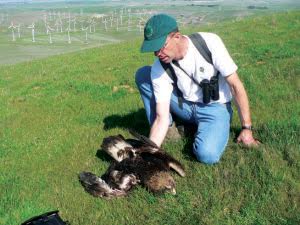
Doug Bell of the East Bay Regional Park District, in a 2007 photo with a golden eagle found near turbines in California’s Altamont Pass Wind Resource Area. The raptor, which had a compound wing fracture, later was euthanized. Janice Gan/Courtesy East Bay Regional Park District

Eagle Take Permit Considered at Hearing

A new federal regulation that would give the wind industry 30-year permits for unintentional eagle deaths was the topic of a recent legislative committee hearing in Casper.

The issue centers on a 2013 U.S. Fish and Wildlife decision that increased the length of eagle take permits from the current five years to 30, but only for wind energy projects and related infrastructure, such as transmission facilities.

A federal judge in California struck down the rule in 2014, shortly after it was issued, after conservation groups challenged it on environmental grounds. This past February the federal government decided it was not going to appeal the court’s decision.

Tyler Abbott, a deputy field supervisor for the U.S. Fish and Wildlife Service, Wyoming Ecological Services, told the Select Federal Natural Resources Management Committee that a new rule was emerging as a result of those actions.

“The Fish and Wildlife Service … is in the process of developing some definitions, some draft regulations and an environmental impact statement that could potentially lead to the authorization of an incidental take permit in the future, but right now it’s in development, and it’s not active legally,” Abbott said.

The proposed new rule would continue to allow 30-year permits for wind energy, but it now also includes a review every five years, bringing it somewhat in line with present permit length. The rule also has stipulations that companies seeking eagle take permits work collaboratively with Fish and Wildlife on a bird protection plan.

READ MORE:  http://casperjournal.com/news/local/casper/article_6c745815-e428-56e1-a79d-7c8883380802.html

Water Wells Useless by nearby Turbines

turbines & water

Water wells made useless by nearby turbines

We found the opinion expressed by letter writer Dean de Jong in the July 22 edition of the Sarnia Observer both hurtful and inaccurate.

With research Mr. de Jong would have realized he has misconstrued the situation. There is a problem in Dover Township and a pending problem anywhere in the area where wind turbines are constructed in this manner in this soil and rock composition.

Mr. de Jong did get one thing right; the situation is about water quality. Had the Ministry of Environment and Climate Change listened to the people of Dover and reacted to their complaints, along with writing meaningful precautions into the Renewable Energy Approval for North Kent Wind 1, this situation could be reported differently and there would have been no need to push to an Environmental Tribunal.

The ministry’s approach of “let them eat cake” or in this case providing farmers with livestock “bottled water” is insulting. We’re afraid it shows there is more than one person out of touch with what is at stake here.

Furthermore Mr. de Jong, we assure you the Health Unit would not test this water, as you cannot see through it. It looks rather like chocolate milk but with a lot of grit. Perhaps Mr. de Jong has the time to invent a way to have a shower, do the laundry or run the dishwasher with “bottled water”.

There is no hidden agenda here. Water Wells First has been abundantly clear that it’s not against the wind turbines, or any other type of renewable energy. What Water Wells First is against is having water wells that have been used for generations made useless by wind developers. The blind compliance to renewable energy demonstrated by the performance of the ministry confirms direction from a Toronto-centric ideology and no concept of what goes on in rural Ontario. Not all water comes out a tap fed by a lake, you know.

Perhaps if Mr. de Jong could see past the anti-wind energy neo-Luddites, as he describes them, he might see the countryside where people have sourced clean natural ground water for generations (why would they stay if they couldn’t?) and understand the irony, in that the majority of these folks’ ancestors used wind energy (wind mills) to pump their water for all those generations.

Seismic coupling – no one is making this up! People, especially rural people, have far more to do than fight to protect their wells from the government they pay for.

K.C. Craig Stainton, executive director

Ontario Ground Water Associaton

and Kevin Jakubec, executive director

Water Wells First

Published July 26, 2016 The Observer: http://www.theobserver.ca/2016/07/26/3500-tags-for-not-an-igloo-project

International Appeal to WHO

download (4)The battle to protect health, our homes and environment knows no border, as renewable energy projects powered by wind globally continue to generate reports of harm.   The WHO is currently reviewing its  European noise guidelines and will include consideration of noise from wind turbines.  Signatories from around the world are calling for careful review of these standards and are uniting those who are demanding protection and prevention of harm to health.

The international letter has been signed by health professionals, researchers and concerned individuals from around the world including Dr Robert McMurtry and Carmen Krogh of Canada, Dr Sarah Laurie of Australia, Dr Alun Evans of Scotland, and acoustician Jerry Punch of the United States, among many others.  Wind Concerns Ontario has signed on behalf of its membership and has sent in a prior letter of comment to the WHO. http://www.windconcernsontario.ca/wind-concerns-joins-international-signatories-on-letter-to-who/

The campaign has been picked up by the media in the UK such as the article in the Press and Journal published on July 21, 2016   http://www.windsofjustice.org.uk/2016/07/health-campaigners-take-windfarm-battle-global/

LETTER: https://www.scribd.com/document/319161091/Open-Letter-to-Members-of-the-Panel-Developing-the-WHO-Environmental-Noise-Guidelines-for-the-European-Region-1-1