Category Archives: Cost Benefit

In your own words

wind turbine shadowGatehouse Media found more than 450 families who have publicly complained about the impacts of living near wind farms. Have a similar experience? Tell your story.

Tell Gatehouse Media about your experience living near an industrial wind farm. 
All submissions will be considered for publication.

Questions? Contact them.
Published stories can be viewed at:
http://gatehousenews.com/windfarms/in-your-own-words/

Big Wind- An Out of Date Solution

Turbines_J.-Marijs_Shutterstock

Rutland Herald| Letter to Editor|December 28th, 2017

A recent Rutland Herald editorial, entitled “Powering up,” concluded that we need to move with urgency toward the renewable power of the future. While that is correct, the editorial goes on to complain that “old ways” of thinking dominate the discussion in Vermont. At issue: the editorial then proceeds to propose “old ways” to move us forward.

When it comes to energy development in Vermont, the industrial wind industry leads the “old way” pack. Wind operators and developers have been living off federal subsidies since the early 1990s and have been wreaking havoc in Vermont for just as long. It’s time to boot them out of the state and employ creative Vermontsized energy solutions.

The editorial employs the “old way” strawman tactic when citing the arguments of industrial wind opponents. Legitimate concerns of Vermonters are minimized when the only argument acknowledged against ridgeline destruction is to mock “the exquisite timidity of those who grieve over birds killed by wind turbines.” It’s a cheap shot that does nothing to advance the conversation.

We should instead be talking about the entire range of problems industrial wind development brings to Vermont: mountaintop dynamiting, destruction of intact eco-systems, stormwater runoff, habitat destruction, habitat fragmentation, noise and health impacts to neighbors and wildlife, safety risks, community division, aesthetic degradation, tourism, property devaluation, and, yes, impacts on birds, bats, and even bears.

We should also talk about what does and doesn’t work. As environmentalist Suzanna Jones recently told us, “Despite the platitudes of its corporate and government backers, industrial wind has not reduced Vermont’s carbon emissions. Its intermittent nature makes it dependent on gas-fired power plants that inefficiently ramp up and down with the vicissitudes of the wind. Worse, it has been exposed as a renewable energy credit shell game that disguises and enables the burning of fossil fuels elsewhere.”

The editorial expresses concern about mass extinction facing numerous species around the globe. Bravo! Then let’s protect the ecosystems that will enable those species to migrate, adapt and survive and abandon the “old way” of thinking that allows our ridgelines and forest habitat to be destroyed by energy developers and their energy sprawl. As wildlife biologist Sue Morse tells us: “New England’s ridgelines will play an increasing and integral role as global climate change forces countless species of plant and animals to seek new habitats in which to adapt and survive.”

The editorial call for an improved large-scale infrastructure capable of transmitting intermittent power from remote, industrial-scale wind plants is another “old way” solution; rural areas are sacrificed to enable our unsustainable wastefulness. Treasured areas like the former Champion Lands, once valued for their ecological significance, become collateral damage. Large-scale transmission from rural to urban areas is a misguided “old way” use of our resources.

There is both wind and sun in our urban areas (Lake Champlain Wind Park, www.champlainwindpark.com) anyone?). We should be supporting renewable development in already-developed areas while protecting undeveloped areas.

We should also be emphasizing community scale generation facilities sited in the communities that they serve. This would reduce energy loss over lengthy transmission lines, improve system reliability, and preserve our vital wildlife habitat. This is the Vermont-scale approach that is in tune with Vermont values.

Some view turbines on distant ridgelines as a visible sign of our commitment to climate action. They’re wrong. A closer look shows that those turbines are exacerbating the very climate impacts that we wish to avoid. Industrial wind plants are putting money in the pockets of investors, developers and a few landowners, but they’re not addressing the very real and pressing problem of climate change.

The industrial wind lobby is fond of saying say we need to make sacrifices. We do. But where those sacrifices come from, whether or not they’re effective and, most certainly, who profits and who loses from them should shape our solutions. We need to change the way we live, we need to stop being so wasteful, and we need to support solutions that actually work. We need to invest in unsexy work of weatherization, efficiency and demand reduction. We should support renewable development in already-developed areas and prevent new development in resource rich areas. We should be focusing on the least destructive renewable technologies and develop microgrids around community scale generation.

Yes, we need to sacrifice, but that doesn’t mean sacrificing our natural resources. It means changing the way we live and protecting the earth. All of it.

Noreen Hession is a retired engineer, community organizer and environmental activist who lives in the Northeast Kingdom.

Fully and Finally Resolving Falmouth’s Wind Debacle

mjoecool's avatarFalmouth's Firetower Wind

Entering-Falmouth-sign-4-990x250

Closure rides on the Elder et al v. Town of Falmouth Case

This pending case appeals the building commissioner and the ZBA’s decision wherein both are claimed to have incorrectly interpreted the by-law to allow the issuance of a building permit (Mar 2010) for Wind 2.

The Eilder group’s defense is grounded in a related action by the Court (Drummey v. Falmouth, 87 Mass. App. Ct. 127 (Feb 2015)), wherein Wind 1 required a special permit as part of a comprehensive bylaw scheme to control wind turbine placement and impact in the town.  Drummey v. Falmouth was the definitive case forcing then Building Commissioner Eladio Gore to order the town to apply for a special permit for Wind 1. Building Commissioner Gore claimed Wind 2 was not addressed in Drummey v. Falmouth, and was thus exempt from his Wind 1 order.

In light of recent events (Falmouth…

View original post 508 more words

Santa’s Moving to the South Pole

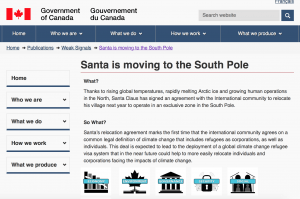
santa moving to south pole
Source: http://www.horizons.gc.ca/en/content/santa-is-moving-to-the-south-pole
SAY WHAT?!  Seriously you cannot make this stuff up and it’s certainly no joke. The Canadian government has been spending our tax dollars on candy cane tainted fluff and it has truly lost its mind. The media world wide has been buzzing (Canada: Santa’s Moving To South Pole Because of Global Warming ) over a recent posting claiming Santa will be relocating to the South Pole as a refugee due to climate change.

Who is Horizons Canada? How is it influencing the political climate in the ongoing battle against the lived experience of harms from wind powered facilities?

Who we are

Policy Horizons Canada, also referred to as Horizons, is an organization within the federal public service that conducts strategic foresight on cross-cutting issues that informs public servants today about the possible public policy implications over the next 10-15 years.

Horizons’ mandate is to identify emerging policy issues and explore policy challenges and opportunities for Canada, as well as to help build foresight literacy and capacity across the Government of Canada. Horizons’ experienced futurists provide expert advice on emerging issues, foresight and scanning through one-on-one discussions, interdepartmental meetings, and facilitated workshops. All engagement requests are discussed collaboratively at the Horizons’ senior management table on a weekly basis. To engage with Horizons, please submit your request to questions@horizons.gc.ca.

Policy Horizons Canada is governed by the Deputy Ministers’ Steering Committee.

Vision: To promote a high and sustainable quality of life within a globally competitive Canada, through the co-creation and advancement of knowledge that informs and structures policy choices for the Government of Canada by way of an integrated and longer-term perspective.

Mission: To provide timely and integrated perspectives on emerging policy issues for the Deputy Minister community by: bridging people, ideas, data, issues and evidence in an open and constructive environment; co-creating knowledge for understanding complex Canadian policy challenges; and experimenting with new tools and methods.

Source: http://www.horizons.gc.ca/en/content/who-we-are

Exploring trends and postulating the future, Horizon Canada sees government policies dancing with wind and other renewables such as solar, fueling everything from the grid,  to the internet and transportation.

Emerging “Urban” Electric Grids

Increasing demand for electricity coupled with emerging sources of electricity production and storage could require new (smart, decentralized) approaches to managing the urban power grid. Over the next 10 to 15 years, cities’ power sources may shift to incorporate much higher levels of renewable energy. A growing digital economy powered exclusively by electricity, coupled with a rapid transition from fossil fuel to electric fuel for transportation(link is external) and housing could substantially increase the demand for electricity in urban areas. At the same time, declining costs of decentralized and distributed energy systems could reinforce urban energy security and pave the way for cities to reach their climate change targets. The installation of in-home batteries and renewable energy sources (solar or wind power) on private homes, public buildings and infrastructure facilities (such as warehouses and factories), and the use of vehicle-to-grid technology(link is external) could eliminate concerns over managing peak demand and allow power exchanges between households. This shift may increase pressure on centralized power utility companies to adopt a business model focused on decentralized energy systems with multiple owners.

Canada 2030: Scan of Emerging Issues – Infrastructure

santa and reindeer 3


Puppets on a string

Puppets-cover-640x430

Credit: Emmetsburg News|December 19th, 2017

At the Supervisors meeting of Oct 24, they adamantly denied the accusation that they had effectively let Invenergy and MidAmerican Energy write the Palo Alto County Wind Energy Ordinance. However, documents obtained by way of the Iowa Open Records Act indicate otherwise. The original ordinance, written Aug 11, 2016, clearly did not meet with Invenergy’s and MidAmerican Energy’s approval. In a memo from Invenergy and MidAmerican Energy to the Supervisors dated Aug 26, 2016, the company states, “there are some key provisions that must be changed if the county desires to attract and encourage the development of wind energy conversion systems” Following are some specific examples comparing the original ordinance with the one modified to meet Invenergy’s demands.

Compliance with Palo Alto County Zoning Ordinance: Original: “requirement to obtain a certificate of zoning compliance in accordance with Article 9, Section 5 of the Palo Alto County Zoning Ordinance.” – Modified: zoning compliance eliminated.

Setbacks from Permanent Residential Dwellings: Original: 2640 ft.- Modified: 1500 ft.

Setbacks from Property Lines: Original: 1000 ft. – Modified: 120% of height of wind device (approximately 600 ft).

Setbacks of Wind Energy Accessory buildings from permanent residential dwellings: Original: 2640 ft. – Modified: 1500 ft.

Shadow Flicker: Original: “No wind energy conversion system shall be installed in any location where shadow shall fall on any existing residential structures.” – Modified: “The owner-developer shall use shadow flicker computer modeling to estimate the amount of shadow flicker anticipated before mitigating any of it.” (How reassuring it is to learn that how I feel about my health will be determined by an energy company’s computer model.)

Drainage Systems: Original: “Permit required if underground electrical construction activity spans across organized drainage districts and private tile systems. – Modified: No permit required for affecting private tile systems.

These are just some of the many changes demanded by Invenergy and MidAmerican Energy to increase the profitability of their project. Clearly most of the Supervisors, with assistance from other county employees, capitulated to every demand, without considering residents who are adversely affected by the project, and who elect and pay these county officials to look after their well-being.

Instead, these same officials have forfeited the health, environment, and homes of some of their constituents to generate huge profits for companies like Invenergy, Mid-American Energy and its billionaire investors like Warren Buffet, and large wealthy landowners, most of whom are absentee. Nearly all major projects such as this involve costs and downsides, as well as any benefits. In this case there are many downsides, starting with the ill health effects on humans caused by shadow flicker, audible noise, and worst of all, infrasound, which can cause stress, sleeplessness, and nausea. Further, there can be adverse effects on farm animals as well. Also, wind turbines can kill many birds, especially when placed too close to lakes and wetlands. Therefore, it is so important to follow regulations and perform due diligence, neither of which has been undertaken by our county officials.

Dr. Stephen Mathis

Professor Emeritus,

Shippensburg University,

Emmetsburg


Fighting Words in Milford

vive a la resistance 2Credit:  The Intelligencer | December 20, 2017 | ~~

Experience is something you get right after you need it. On the heels of a potent, jam-packed rally in Milford to implore the government to pack up its turbines and go home, the bitter aftertaste and lingering sting of feeling deceived and betrayed remains ours to mourn and avenge.

When you think about it, the optics of investing in wind turbines can be construed as a patriotic opportunity to demonstrate support for green energy when better options may exist, but this turbine project is lead contender for first place as a blue ribbon colossal failure.

Clearly, Premier Wynne doesn’t want to be confused with facts, she has already made up her mind. Wynne is at the helm of The Ontario Green Energy Act – the largest transfer of wealth in Canadian history, and as it crosses the performance finish line, it’s lagging behind, Wynne thinks it came in first. As recited in quote after quote: The net result is this is the most over- priced, inefficient, redundant, useless subsidized wind power electricity in North America, never mind Ontario. All supply with no demand. Ontarians have an abundant supply of apologies and Mea Culpa’s from the Ontario Energy Minister for “sub- optimal outcomes”.

The notion of erecting seven 480’ turbines in Milford is just plain ludicrous, although the reality is easily heard by the heavy, gravel- laden trucks barreling down County Road 13 providing thunderous, early morning wake- up calls. The ugly esthetics beginning to sprout will impose a fire sale price tag for potential business investors in Milford and has struck fear in seniors inflicted with depressed residential land values while huddled beneath the looming white elephants. This is the Canadian government that has shoved its citizens to the sidelines to put up and shut up while they impose incompetent, environmental destruction upon a gentle community.

The knights of South Marysburgh tilting at wind turbines are growing in numbers scattered across the belly of South Bay in a mission to quash the project. Appointing Milford for monolithic wind turbines flies in the face of all that is naturally beautiful, peaceful and harmonious in the County. The 800- miles of shoreline tucked into warm, white sand dunes, tropically- hued waters, wine, food, farming, olive oil, maple syrup and bursting with artistic bounty is sacrilegious.

While defending both professional and personal scrutiny, perhaps Mayor Quaiff has the right idea, attacking the issue from within? After all, one of the most successful strategies every employed is “the enemy of my enemy is my friend”.

Milford owns the mouth’s that roar “we are mad as hell and won’t take it anymore” and it has fallen on the selected hearing of Wynne. Steve Ferguson closed his speech at the APEC annual general meeting last Sunday, quoting McGuinty “they (the public) can’t stay mad at us forever”. In Milford, Ontario, those are fighting words.

Mary Malone
Milford

Source:  The Intelligencer | December 20, 2017 |
Reposted from:  National Wind Watch

Wind Turbine Poetry Throwdown at Queens Park

santaslumpofcoal2.jpg
Ontario’s Wind turbines raised during question period

Question period saw a lively  exchange of Christmas poetry with wind turbines issues being raised  in Ontario’s  Parliament:

WIND TURBINES
Ms. Lisa M. Thompson: My question is for the Premier:
Wind turbines still go up against a town’s will,
Just like the Grinch ignoring councils,
this gives Liberals a thrill,
They swear that the turbines are all science-based.
But will she admit real noise pollution proves
that’s just not the case?
Hon. Kathleen O. Wynne: Minister of Economic
Development and Growth.
Hon. Brad Duguid: ’Tis the session before Christmas
And I note with much joy,
The kids in our land
Will enjoy plenty a toy.
Our unemployment rate
Is the lowest in years.
This Christmas we may
Even enjoy a few beers—
from grocery stores, nonetheless.
And so we wish you all
The best of the season,
And hope that next year
The opposition will engage with more reason.
The Speaker (Hon. Dave Levac): Supplementary?

≈≈≈≈≈≈≈≈≈≈≈≈≈≈≈≈≈≈≈≈≈≈≈≈≈≈≈≈≈≈≈≈

Mr. Rick Nicholls: “Wind turbines must go,”
but the Liberals ignore
The demands of the people, as they loudly implore.
In the Alley of Carnage, the snow piles so high,
But the need for a barrier will they always deny?
Hon. Brad Duguid: It’s still the session
before Christmas
And it’s almost done.
It’s nice to spend time in this House
And even have fun.
We may be opposed to many an issue,
But when we leave this place
Rest assured,
We will miss you.
Let us focus this session
On those that are in need,
And let us work together
So Ontario can still lead.

Source: Hansard Ontario Dec.14.17

Ontario’s Opposition Party “Twas the last QP before Christmas Break”:

https://www.facebook.com/plugins/video.php?href=https%3A%2F%2Fwww.facebook.com%2Fvotepatrickbrown%2Fvideos%2F732796846918522%2F&show_text=0&width=560

End of procurement of new contracts

“As a result of the province’s robust supply situation and flat yearly demand for electricity, the procurement phases of the IESO’s Feed-in-Tariff (FIT) and microFIT programs have come to an end. These programs have been instrumental in helping Ontario establish the clean energy supply mix it has today.”
IESO December 12th, 2017: Ontario’s electricity system ready for winter

Rays of light through the open white door on orange wall
Door closes on procurement of  new FIT & microFIT contracts for renewable energy in Ontario

Good riddance and don’t let the door hit you on your way out!   Now to move onto the next order of business-canceling existing wind power contracts and halting construction of additional projects.

LETTER: Government should do a cost-benefit analysis of the wind sector

letterstotheeditor

We were both astonished and upset to read the article printed on December 1st, accusing communities fighting wind turbine developments as being funded by the nuclear and fossil fuel industry. Nothing could be further from the truth!
We have seen first hand the struggle these communities face in raising the necessary funds to fight these industrial developments in the courts, through individual donations, taking out loans and organising community fundraisers.
It is the wind farm industry itself, which has become a ‘vested interest,’ relying on subsidies, grants and tax payer’s money. The recent report painstakingly researched by Wind Aware Ireland shows that the wind industry is costing us €1.2 billion annually as a nation.
In return for this, they have failed to significantly reduce our carbon emissions. It must also be realised that wind energy generates electricity, which accounts for only 20% of this country’s total carbon emissions.
Wind farms have become the easy option as the developers and investors are guaranteed profits through the Renewable Energy Feed-In Tariff (REFIT), which subsidises them and is paid for out of the PSO levy on each ESB bill. Central government has failed to do any cost-benefit analysis of the wind farm sector, to see if it is of any benefit to the country.
Meanwhile, rural communities have to stand up to these inappropriately-sited wind farm developments. Once they are built, they will provide no employment for the area and instead will reduce property values, keep tourists away and depopulate our countryside further.
There is also a growing body of evidence that ultra and infra sound generated by turbines have significant health effects on local residents. Most other countries have increased the regulations about the siting of wind farms, while in Ireland we are still subject to 10-year-old guidelines, made when turbines were one third of their present height.
Successive governments have promised to update these guidelines, but so far have failed to change them. We believe we have to look beyond the stranglehold of the wind lobby to other more effective ways of meeting our CO2 targets, including a mix of other renewables and a concerted effort to reduce our energy consumption.
Yours sincerely,
Tony Miller & family,
Dunmanway. Ireland

Published: Saturday, 9th December, 2017  The Southern Star

Ontarians taking it on the chin (& wallet)

money & plug

Ontario Auditor zaps power firm charges

THE CANADIAN PRESS
Wednesday, December 6, 2017

TORONTO  – Soaring power prices, wind farms imposed on places that don’t want them and now this: Ontario consumers being dinged by power companies for things such as raccoon traps, scuba gear and staff car washes.

Zapped before by the province’s spending watchdog for its handling of the energy file, Ontario’s Liberal government — heading into an election year — took it on the chin again Wednesday in Auditor General Bonnie Lysyk’s annual report, which found ratepayers have footed the bill for up to $260 million in ineligible expenses under a provincial program that puts the producers on standby to generate power.

She also found ratepayers are paying the cost for large industrial companies’ electricity savings, and that Ontario’s Independent Electricity System Operator (IESO) hasn’t implemented repeated recommendations from the Ontario Energy Board, including one that could save ratepayers $30 million a year.

Lysyk’s latest report looked at a program that pays power generators for fuel, maintenance and operating costs when the IESO puts them on standby to supply energy. Nine generators claimed up to $260 million in ineligible costs between 2006 and 2015, Lysyk said.

About two-thirds of that has been paid back.

One natural gas plant in Brampton “gamed” the system for about $100 million, the energy board, the province’s regulator, has reported.

Generators claimed thousands of dollars a year for staff car washes, carpet cleaning, road repairs, landscaping, scuba gear and raccoon traps, “which have nothing to do with running power equipment on standby,” Lysyk wrote.

One company claimed about $175,000 for coveralls and parkas over two years, she said.

“The program was such that bills could be submitted but without any support for the bills and the bills were being paid, and it wasn’t until more requests were made for detailed information that (the IESO) became aware that there were costs behind that bill that probably shouldn’t be reimbursed,” Lysyk said.

Lysyk had previously skewered the Liberals over electricity, concluding customers paid $37 billion for the government’s decisions to ignore its own planning process for new power projects, and that a $2-billion smart meter program spent double its projected costs and didn’t ensure conservation goals were met.

Her conclusions about the smart meter program led then-energy minister Bob Chiarelli to say the auditor’s numbers were less credible than his because the electricity system is complex and difficult to understand. Lysyk spent 10 years working at Manitoba Hydro.

The program to pay costs when energy suppliers are put on standby began in 2003, when Ontario’s electricity grid had supply issues, but now the province has surplus power.

Read Article