Category Archives: Cost Benefit

Can’t Make This One Up

The absurdity for money making associated with wind power knows no limits.  Now you can purchase insurance to protect and maintain your cash flow when that pesky thing called weather interferes with your renewable energy installation.  No need to fret over wind or sun resources above or below par. Maintaining financial performance even with the sun doesn’t shine or the wind doesn’t blow (or blows too fast).

Weather Risk Transfer:

“For businesses and entities working in the renewable energy sector, the single greatest and most significant factor influencing availability and performance is weather. Wind and hydroelectric generators, in particular, face a persistent challenge as they look to manage the intermittency of wind and water resources.”

Source: http://www.gcube-insurance.com/en/coverage/weather-risk-transfer/ 


Controversial Donation tangles Lambton County Council

How does Lambton County end up taking money from a wind project it has been engaged in supporting residents bitter opposition to?  The County is being taken to task  over its recent action.  A staff report is to look at the process of how such tainted donations are accepted.


Agreeing that it’s too late to change the past, Lambton County Council has set new guidelines for handling possible donations from wind power companies.

Lambton’s Creative County Fund accepted a $200,000 donation from the Cedar Point II Wind Power Project in December.

Members of county council were not informed and many expressed concerns after, given the history of the project in Lambton County.

Sarnia Mayor Mike Bradley hopes it never happens again.

“I think there was a great deal of disappointment and anger here, that the donation was accepted from a corporation, the industrial wind turbine group, who this county has been opposed to over the last three years and have gone to the courts to support the different organizations that have been fighting these industrial wind turbines,” says Bradley.

In the future, council has decided that all donations and financial or policy decisions pertaining to industrial wind turbines will be referred to county council.

County council also endorsed a motion from St. Clair Township Mayor Steve Arnold, asking staff for a report on how the donation receipt process works.

READ AT: http://blackburnnews.com/sarnia/sarnia-news/2017/02/01/county-sets-new-guidelines-controversial-donation/

Residents already tapped Out

image3
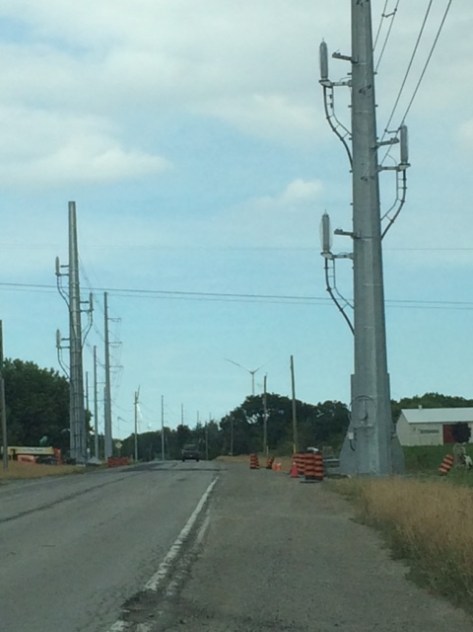
Transmission poles for Niagara Wind in West Lincoln, Ontario

Grimsby Lincoln News   Re. An investment in the future, Letter, Jan. 10:

I disagree with the mayor about the future of West Lincoln.

Our council has taken on a project estimated to cost $23.6 million with no firm plan except that they have set their sights on achieving a new arena and recreation complex before the next election.

In 2015, council turned down a proposal for a $14-million complex because funding was not complete, and now they have plans for a $23.6-million complex and still have no funding in place, no business plan, and no estimate of operating expenses. They have, however, decided to place all funds they anticipate receiving from the wind projects: the Community Impact Fund, the Road Use Agreement, and the funds equal to the replacement of the 7,000 trees removed by the wind company, into the project.

Council also brags about the 3.5 per cent tax increase to the 2017 budget as the final increase when they are actually planning a 13.6 per cent increase phased in over three years.

Now they are asking this community to start fundraising. Many of us have spent thousands of our own dollars (and thousands of hours of our time) on just attempting to keep the wind company compliant with no help from this township. Residents of West Lincoln have had to put their own funds into purchasing noise monitoring equipment, with no support from our council. Our council never done anything to help the residents of West Lincoln, except to sign the documents allowing them to collect the bribe money from the project.

West Lincoln in 2017 has 49 industrial wind turbines, miles of transmission lines, guard rails and utility poles, and families facing problems with water quality, noise, shadow flicker, sleeplessness, health issues and stress.

I expect to see more and more issues with the wind projects in the future and huge tax increases for years to come just to maintain this recreational complex.

Nellie DeHaan, Smithville

Published January 17, 2017

New Year New Resolve

dscn1859The Multi Municipal Group is starting off the New Year with a public declaration and continued resolve to fix Ontario’s Green Energy Act.

January 3 2017

Public Declaration Concerning : the exploitation of rural Ontario by the Government of Ontario and the wind power development industry


Electricity Costs Kills Belgium Hall

c03nkm8xgaajg0j

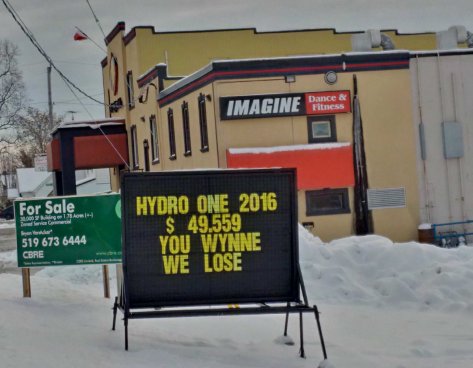
You Wynne We Lose. Sign outside Delhi Belgium Hall

Electricity Costs bring down Delhi Community Hall

It is claimed wind projects bring many economic benefits in a green economy to society but in reality they are killing the economic viability for many community groups. Expensive renewable energy contracts are a driving force pointed at as responsible for escalating the costs of electricity beyond sustainability.  Green ideology tearing apart the binding fabric of our communities one after another and another.

Club gives tip of the hat to Premier Wynne

By Monte Sonnenberg, Simcoe Reformer Thursday, December 29, 2016 6:15:22 EST PM

There will be no more banquets, wedding receptions, concerts, trade shows or public meetings at the Delhi Belgian Hall for the foreseeable future.

However, the Shields & Friends Lounge in the lower level of the sprawling complex will continue receiving patrons and serving drinks into 2017.

That according to the bar’s manager Kim Starling. Starling was hired in October soon after the Belgian Club announced it was pondering its future in the face of punishing utility bills and declining rentals.

In late October, the club executive announced that its financial problems were insurmountable and that the historic property would be sold.

They weren’t bluffing. Today, a sign is posted out front advertising the 30,000-square-foot building for sale. The asking price, according to the realtor’s website, is $899,000.

There is also a second sign out front expressing the club’s bitterness over skyrocketing electricity prices and what that has done to the hall’s viability as a community centre.

The sign says: “Hydro One 2016: $49,559. You Wynne, We Lose.”

Some of the hall’s monthly hydro bills this year were as high as $5,700. Even with 1,200 members, the club concluded it can’t go on carrying a burden like this.

The timing of the hydro whammy is especially unfortunate. The hall’s heating-ventilation-air conditioning system needs to be replaced. The building’s electrical system also needs updating.

If the club finds a buyer, Starling hopes the hall can continue forward in its current format.

“That would be nice,” she said Friday. “That’s how I’d like it to be. I’d hate to see the building go.”

In its promotional literature, realtor CBRE Ltd. of London says the 1.78-acre package has a lot of potential uses.

CBRE notes that 360 James Street has a service commercial zoning. In Norfolk County, this allows for a wide range of commercial applications.

The property, CBRE adds, comes with a “large lot with plenty of excess land for parking or further development.”

The Belgian Hall was founded in 1948 as a meeting place for the wave of Belgian families that settled in this part of southern Ontario after the Second World War. The hall earned a reputation in southern Ontario in the 1970s as a premier showcase for up-and-coming rock bands.

Acts that performed at the Belgian Hall include Ronnie Hawkins, Rush, Lighthouse, The Stampeders, April Wine, Max Webster, Blood, Sweat & Tears, and Bachman-Turner Overdrive.

MSonnenberg@postmedia.com

READ AT: http://www.simcoereformer.ca/2016/12/29/club-gives-tip-of-the-hat-to-premier-wynne

Big Oil turns on to wind power

swindle-bus-311Big oil and its relationship to wind power is not new for opponents of wind turbine projects. Community groups opposing harmful impacts of wind power will enviably face inaccurate accusations they are puppets funded by big oil masters. Careful examination of parent companies of wind facilities in Ontario find the limited partnerships are often cleaved from entities using fossil fuel power generation as its principle source for profit making. Electricity made in these companies power plants is done mainly by using fossil fuels (such as natural gas). It has been claimed that the big oil incorporations not only follow the lure of subsidies but they also helped to create the current political stage and renewable energy policies.  This in turn fuels the spin of green energy money markets. Following the money it is clear making money remains the primary goal. Managing the marketing of big oil’s image held by consumers makes how electricity is generated just an after thought.

“It remains unclear if offshore wind can be a steady moneymaker without government support, which besides tax credits and minimum rates can include guaranteed access to power grids.”

Oil producers turn to wind power 

Credit:  Zeke Turner, Sarah Kent | Dow Jones | December 27, 2016 | www.theaustralian.com.au ~~

The Netherlands wants to build the world’s largest offshore wind project, and an unlikely company is helping: Royal Dutch Shell.

The oil-and-gas giant is facing shareholder pressure to develop its renewable business. Add in falling construction costs for such projects, and Shell has decided to join a handful of other oil companies aiming to leverage their experience drilling under punishing conditions at sea.

Norway’s Statoil is already building its third offshore wind farm, in the Baltic Sea, and is developing the world’s first floating wind farm off the east coast of Scotland. Denmark’s state-owned Dong Energy – once a fossil-fuel champion – is now the biggest player in the offshore wind market.

A Shell-led consortium won a bid this month to build and operate a portion of the Netherlands’ giant Borssele wind project in the North Sea. Once complete, the Shell-built section will generate enough power for roughly a million homes at a price of €54.5 ($A79.20) per megawatt hour – a customer rate approaching that of cheaper power sources like coal or gas.

Offshore wind’s competitiveness is highly subject to local power prices and government measures, including tax credits, subsidies and rate guarantees. Nonetheless, in European markets, the wind industry had thought near parity was years away.

“Right now the offshore wind project is competitive with any power source,” said Dorine Bosman, Shell’s manager developing its wind business.

Offshore windpower projects involve driving steel foundations into the sea floor for towers that support building-size turbines with propellers wider than the wingspan of an Airbus A380. Though historically more expensive to build than onshore wind farms, offshore projects can take advantage of less restricted space and stronger, more consistent winds.

The technological arms race to build these complex projects economically is so heated that many companies, including Shell, won’t disclose how much they are investing, treating their commitments like a trade secret.

Fossil-fuel companies’ push into wind reflects their growing sensitivity to global efforts to limit climate change and how that will affect consumer demand for their main offering: oil and gas.

France’s Total wants 20 per cent of its portfolio to consist of low-carbon businesses within the next 20 years. Shell established a new division this year focused on investing in sources such as wind, solar and biofuels. Statoil has a $US200 million fund for projects such as wind technology and batteries.

Investments by big European oil companies in wind and other renewable energy sources remain small – around 2 per cent of their overall capital-spending budgets, according to McKinsey. The industry is cautious about betting big on alternatives after getting burned in the past.

It remains unclear if offshore wind can be a steady moneymaker without government support, which besides tax credits and minimum rates can include guaranteed access to power grids.

“It should be the ambition of everybody to not have subsidies,” Ms Bosman of Shell said.

Lower costs – brought on by technological improvements, economies of scale and low interest rates – are helping move the sector in that direction. Earlier this year the windpower industry was targeting a price of €100 per megawatt hour by 2020; subsequently three auctions of project rights this year in the Netherlands and Denmark settled on rates below that level.

Shell previously pulled back from involvement in offshore wind that proved unprofitable and says it will be primarily an oil-and-gas supplier for decades to come. But the improving economics of wind power have prompted the company to dip its toe back in the water, joining others in crowding the heavily subsidised specialists that once dominated the sector.

Dong Energy has sold off a large portion of its fossil-fuels business, including five Norwegian oil and gas fields, and now has 29 per cent of the world’s built offshore wind capacity, according to spokesman Tom Lehn-Christiansen. Goldman Sachs Group Inc. took an ownership stake in Dong Energy in 2014, and the company went public in June.

Statoil has invested $US2.1 billion since 2010, or about 20 per cent of a single year’s capital budget, in offshore wind parks. After two years of whipsawing oil prices, offshore wind’s relatively stable prices are dreamlike for oil executives, said Irene Rummelhoff, Statoil’s executive vice president for renewables.

Even Exxon Mobil, which hasn’t put the same emphasis on renewables, has dabbled with the technology, with the idea of using floating wind turbines to help power its offshore oil and gas platforms.

Although solar power is expected to be the fastest-growing renewable energy source over the next five years, the International Energy Agency forecasts offshore wind capacity will triple by 2021. While that will remain below 1 per cent of global capacity, the growth prospects are particularly attractive in regions such as Northern Europe where sunlight is in short supply for half the year.

Japan, China, India and Taiwan are all poised to place bets on offshore wind now that its cost is coming down, according to the industry group Global Wind Energy Council.

In the US, President-elect Donald Trump has been sceptical of wind power, warning of its cost, unsightliness and risks to wildlife. However, Texas was a forerunner of onshore wind energy in the US under the watch of former governor Rick Perry, Mr Trump’s pick to lead the Energy Department.

Offshore wind in the US got a boost this month when the country’s first park went online off the coast of Block Island, Rhode Island. Days later, Statoil won a bid for a potential project in the Atlantic Ocean south of Long Island – its first offshore wind lease in the US.

Jeffrey Grybowski, CEO of Deepwater Wind, which developed the Block Island project, said the oil companies will face a tougher landscape in the US compared with Europe because of bureaucratic hurdles and fewer incentives.

“We think our competitors are going to have a lot to learn,” he said.

Dow Jones Newswires

Source:  Zeke Turner, Sarah Kent | Dow Jones | December 27, 2016 | www.theaustralian.com.au

Ontario Christmas Lights

Do you like my Christmas lights? 

black-background

Oh Sorry.  I live in Ontario and can’t afford to turn them on.

D’Amato: Hydro woes will finish Liberals

Dec 14, 2016 Waterloo Region Record   By Luisa D’Amato 

 “Do you like my Christmas lights?” asks the latest joke circulating on social media.

The sentence is written in white on an imposing inky-black background. It’s puzzling for a moment as you stop to ask yourself where the lights are.

But then you get it. At the bottom of the black square is the punchline: “Oh sorry, I live in Ontario and can’t afford to turn them on!”

What is it with fuel and the Liberals, anyway? The political career of former Premier Dalton McGuinty was dashed by his party’s decision five years ago to cancel planned natural-gas plants in Oakville and Mississauga, costing Ontarians more than a billion dollars.

Today, high electricity prices are doing the same thing to the political career of Premier Kathleen Wynne. Out-of-control prices have put a chokehold on small businesses, the engines of job creation. Moreover, some families are forced to use dangerous portable heaters because they don’t have access to their electricity. It’s a crisis.

Politicians in power devote a lot of time and energy toward pretending that nothing is wrong, when it really is. But when you watch televised newscast clips of Wynne (whose approval rating is now at the lowest of any premier in Canada, at 16 per cent), you can see how rattled she seems to be.

While it’s touching that she takes responsibility, the politicians don’t quite seem to understand the significance of what’s happening. In one videotaped interview I saw, Energy Minister Glenn Thibeault agreed it must be “disconcerting” to have the power cut off because you can’t pay.

Not exactly, minister. “Disconcerting” is when someone else beats you to those prized theatre seats in front row mezzanine. Not being able to pay your hydro bill is a whole different thing. It’s crushingly stressful. It’s soul-destroying.

The opposition gets it. Both the Conservatives and New Democrats regularly pound the Liberals on this topic in the Ontario Legislature. New Democratic Party leader Andrea Horwath was in Cambridge on Tuesday to meet with a woman who struggles to pay hydro bills.

Think about why costs are soaring and you encounter the fatal flaw of the 13-year-old Liberal government. It meant well. But there’s a big difference between having a grand visionary outlook and actually being able to manage something.

Give McGuinty credit for dreaming up the idea that we could put people back to work and help save the environment. He thought it would create jobs for Ontario to produce wind turbines and solar panels. As an incentive, the government offered lots of money to buy the power back. That’s part of what put prices up so high, so quickly.

There’s more. The difference between low market prices and the higher prices promised to these new producers of wind and sun energy is called the “global adjustment charge.” Between 2006 and 2015, we paid an unnecessary $50 billion subsidizing this vision, Auditor General Bonnie Lysyk says.

That subsidy accounts for 70 per cent of consumers’ electricity rates in 2013. But the difference between the market price — what we would be paying if the Liberals had left well enough alone — and the global adjusted rate isn’t clear on our bills. Lysyk says it should be. The government, unsurprisingly, wants to leave it murky. Because obfuscation is all they’ve got left.

ldamato@therecord.com

READ AT: http://www.therecord.com/opinion-story/7018820-d-amato-hydro-woes-will-finish-liberals/#.WFoJO-S5h8k.twitter

Is the FIT really Dead?

zombie.pngThe flames of political fires are blowing hot shifting winds of change creating a scorching backdraft for Ontario’s renewable energy program. The Minister of Energy’s latest directive spells out the end of FIT application procurement (feed -in -tariff). FIT 6 is to be pronounced dead as of  the end of December.

“The final FIT application period will be held in 2016. The IESO shall cease accepting applications under the FIT program by December 31, 2016 and any unallocated procurement target at the end of that procurement process will remain unallocated”

A tiny step heading in the right direction. It is never too late to do the right thing and is on the right path of cancelling wind contracts.

Minister of Energy- Glen Thiebault’s December 16, 2016 Directive:


Ontarians Are Not Confused

mackay-cartoon-dec-15-16
Mackay  Editorial Cartoons

http://mackaycartoons.net/2016/12/14/thursday-december-15-2016/

December 14, 2016
Hamilton Spectator

OEB actions paternalistic

Last month, the Ontario Energy Board decided to protect rate payers from knowing how much the Liberal government’s cap-and-trade policy would add to their monthly gas bills.

Now the OEB has decided to relieve us of the burden of knowing how much the government’s electricity policies are affecting our monthly hydro bill.

The OEB, it seems, is worried that too much information may confuse the average Ontario taxpayer. At least that’s how they responded to Auditor General Bonnie Lysyk’s request that hydro bills be changed to increase “the awareness and transparency” of the impact of the so-called “global adjustment charge.”

The global adjustment is an extra charge that is levied to cover the gap between the guaranteed prices the Liberal government promised electricity generators in 20-year contracts and the actual market rates.

Lysyk has estimated that global adjustment accounted for 70 per cent of consumer electricity rates in 2013. If so, that’s something that should be plainly disclosed on every hydro bill.

For the OEB to contend that further transparency would only confuse ratepayers is highly paternalistic, if not down right arrogant.

Give us the information. If we get confused, we can call and ask for clarification.

Liberal Energy Minister Glenn Thibeault has again refused to intervene on behalf of the auditor general or the taxpayer on the basis that the OEB is an independent quasi-judicial regulatory body.

That’s very convenient. Thibeault may not have the power to order the OEB to change their ways … but perhaps he can at least ask. He has the power to do that.

As it is, it’s getting harder for the public to take the claim of OEB independence seriously.

Who could possibly benefit from burying the cost of the Liberal’s questionable energy policies … other than the Liberal government?

Graham Rockingham

Hamilton Spectator: http://www.thespec.com/opinion-story/7020499-oeb-actions-paternalistic/

WLGWAG Public Meeting 2016

“This is a community that has said enough is enough,” said Mike Jankowski. Chair WLGWAG

MPP hears of health concerns, excessive tree removal and a new machine to monitor noise

Grimsby Lincoln News December 8,2016

SMITHVILLE—Sam Oosterhoff isn’t an expert on windmills, but the newly elected MPP, did have one thing in common with the members of the West Lincoln Glanbrook Wind Action Group — they both wanted to decrease hydro rates.

Oosterhoff, whose election platform centered on the cost of hydro, connected with the group in their mutual concern about the production of energy in Ontario.

He attended the group’s annual general meeting where he heard about their efforts over the past year and the current state of wind energy in the wake of the Liberal government halting green energy plans.

“Even though the demand for hydro has gone down, our supplies have increased and our costs have increased,” Oosterhoff said to the crowd from inside the Covenant Christian School in Smithville. “We need to be seeing what we can do to make sure it’s competitive across the board.”

Oosterhoff encouraged the crowd to come forward with ideas to tackle the hydro issue and to join the PC Party.

“This is a community that has said enough is enough,” said Mike Jankowski, director of the group.
Speakers at the event reiterated their concerns about the turbines, about the proximity to homes and the physical effect it may have on people. They spoke about the removal of thousands of trees in the area to make way for transmission lines; trees that they say were promised but never replaced.

They also spoke about the overproduction of electricity in the province and the unnecessary amount of debt being incurred by green energy projects such as those in Smithville, Wainfleet and across the province.

The group has now aligned with Wind Concerns Ontario and have purchased equipment that they hope will prove that wind turbines are affecting their health.

 “We have purchased a noise monitoring system,” said Jankowski.

The system, he said, aligns with the Ministry of Environment and Climate change’s monitoring standards.

He hopes that by monitoring the low level noise that is undetected by the human ear they can lay some sort of foundation for government research on the effects of placing wind turbines close to residential dwellings.

Some members of the audience at the meeting spoke of an inability to sleep, a ringing in their heads and a general sense of discomfort since the turbines have went up.

“My goal when I started was, let’s at least erase any doubt as whether or not wind turbine emissions are inside people’s homes,” said Jankowski, who says so far they are picking up noise emissions in nearby homes.

West Lincoln Councilor Joann Chechalk was also present and said she were there to listen.

“I’m very much listening with an open mind,” said Chechalk explaining that she has heard much of the information before.

“The province holds the collar on understanding what that machine is recording; it’s the province that’s going to have to determine whether or not that machine is capturing the information the way that they want it captured.”

READ HERE: http://www.niagarathisweek.com/news-story/7007936-oosterhoff-talks-hydro-rates-with-anti-wind-power-group/