Category Archives: Adverse Health Effects

Wind Power-Experiment in Environmental Ethics

Our Experiment in Environmental Ethics

To the Editor:

Back in the 1960s, Yale psychology professor Stanley Milgram conducted a research experiment whose results shocked the nation.

https://www.youtube.com/watch?v=ek4pWJ0_XNo&feature=youtu.be

Participants were told that they were taking on the role of ‘teacher’ in a study of methods to improve learning. An authority figure told the ‘teacher’ to administer increasingly powerful electric shocks to a ‘learner’ in the next room whenever a question was answered incorrectly. There actually were no shocks and the learner was part of the research team, but the ‘teacher’ heard increasing cries of pain with each ‘shock’ administered. Even as the intensity of the shocks approached the maximum of 450 volts, the authority insisted that the shocks should continue – that the anguished screams, the banging on the wall, the pleas about heart conditions, and ultimately the ominous silence from the other room should all be ignored.

It was believed that most people would defy the authority figure once they became aware that the shocks were seriously harming another person. But that was not the case: almost 2/3 of participants continued to obey the authority figure, administering ‘shocks’ until the very end.

I was reminded of the Milgram experiments recently while attending two Public Service Board hearings on new proposed sound limits for industrial wind facilities. Because there have been problems, a lower standard of 35 dBA, (down from 45 dBA) has been proposed. (The World Health Organization recommends 30 dBA.)
SONY DSC
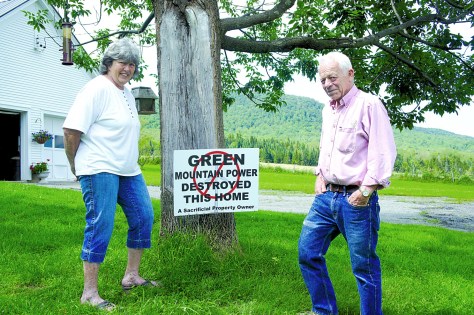
Shirley & Don Nelson- A Sacrificial Property Owner

Those who live close to Vermont’s existing industrial wind facilities have described a range of symptoms that include sleeplessness, headaches, ringing ears, and nausea. For fifteen months, Shirley Nelson, who lived less than a mile from the Lowell wind project, kept detailed recordings of decibel readings (from a monitor installed at their home by the developer, Green Mountain Power) and the health effects she and her husband were experiencing. Entries from her ‘noise diary’ clearly demonstrate the sustained and cumulative adverse effects of living near the turbines at the previous standards.

therriens
Therrien family  abandoned their home after wind turbines became operational

The Therrien family, who lived near the turbines in Sheffield, pleaded for years for relief – from the PSB, the wind developer, the town of Sheffield, former governor Shumlin and other state officials – to no avail. Their symptoms? “Disturbed sleep, headaches, tinnitus (ear ringing), sense of quivering or vibration, nervousness, rapid heartbeat, high blood pressure, nausea, difficulty with concentration, memory loss and irritability.”

At the Montpelier hearing, the lawyer who represents the proposed Swanton Wind project told the Board to ignore these symptoms – dismissing them as coming from “complainers” and “outliers” whose testimony was just “anect-data”. Instead, he said, the Board should focus solely on submitted peer-reviewed studies that show no health impacts from proximity to industrial wind facilities

In other words: trust authority; ignore the pleas from the other room; continue administering the shocks.

What about other peer-reviewed studies showing that infrasound from industrial wind turbines does affect human health? And it’s hard to dismiss as mere “anect-data” the fact that deteriorating health forced the Therriens and their two young children to abandon a home they loved.

At the hearings, several residents of Lowell (perhaps believing that new standards would threaten their cash cow) not only implied that their neighbors were lying about the health impacts they’ve experienced, but claimed to live much closer to the turbines – with no ill effects – than they actually do. And the few supporters drummed up by VPIRG and industry promoter Renewable Energy Vermont callously waved off the impacts on humans, wildlife, land and water. Some actually called for raising the noise standard to make it easier on the industry.

Reading from talking points generated by VPIRG, someone commented, “There are only eight families complaining….”

What is the magic number that will elicit empathy from VPIRG? Thirty families? A hundred?

In the Milgram study, the pain the ‘teachers’ believed they were inflicting was justified by the supposed benefit of a better understanding of human learning. In Vermont, the justification from developers is that industrial wind is a ‘clean’ solution to climate change. And there are politicians, ‘environmental’ celebrities and non-profit organizations willing to put on a white coat and hold a clipboard to pose as the ‘authority’ on the industry’s behalf.

vermont-ridgeline
Vermont mountain ridgeline

But for those who find clear-cutting, blasting, and bulldozing mountain ridgelines, degrading water sources, eliminating wildlife habitat, and killing birds and bats ‘clean’ and ‘green’, take a look at before-and-after photos of entire valleys in China destroyed by the mining of rare earth metals, a critical component in industrial wind turbines. Where there were once thousands of acres of carbon-sequestering grasslands there are now mountains of toxic sludge. Four thousand tons of material must be mined to produce the two tons of metals needed for each 3-megawatt turbine.

Production tax credits, the sale of renewable energy credits, and the requirements of state renewable energy portfolios have made the buildout of industrial ‘renewables’ very profitable for corporations, even when the climate benefits are marginal or non-existent. Utility law professor Kevin Jones at Vermont Law School describes all this as a ‘shell game’ that has actually led to an increase in Vermont’s greenhouse gas emissions.

Clever marketing has induced some of us to engage in moral relativism, ethics without substance, and environmentalism at the cost of its soul. If you find yourself arguing in favor of throwing someone under the bus because your favorite pop-‘environmentalist’ says it’s necessary, ask yourself what you would have done in Milgram’s lab.wind-refugee

Suzanna Jones lives off the grid in Walden.

Suzanna Jones

Walden, Vermont

Letter to Editor Published Caledonia Record on May 22, 2017

Report Shadow Flicker

turbine silouete
May 27, 2017

For anyone experiencing shadow flicker from turbines, and especially if you have been told erroneously NOT to report it, please read this message to us from the MOECC. We advise everyone to report to the MOECC, and the wind power developer but above all, to always include the MOECC in your reporting. Be sure to get an Incident Report number when you call.

MOECC: Thank you for your inquiry. The Ministry remains committed to reviewing and assessing all complaints related to the operation of a wind facility.

To register a complaint, please contact either the local MOECC district office (during business hours), or the Spills Action Centre (after hours).

Complaints received by the Spills Action Centre will be assessed and forwarded to the appropriate MOECC district office for action.

I thank you again for your inquiry.

Shannon Seko

Senior Manager, Spills Action Centre

Ministry of the Environment and Climate Change

5775 Yonge Street, Suite 500
Toronto, ON M2M 4J1

Spills Action Centre -Reports after business hours can be made by calling:

  • 1-800-268-6060 (toll-free, province-wide, 24/7)
  • 416-325-3000 (Toronto area)
  • 1-855-889-5775 (TTY)

Business Hours– Report to your local District Office

Find your local MOECC office 

mnr_offices


Human Health, Rights and Wind Turbine Deployment in Canada

rights and responsibiltiesAbstract: Canada has ratified international conventions which recognize the individual’s right to the enjoyment of the highest attainable standard of health. Despite the adoption of these covenants governments sometimes support policies and practises which trade off individual human health with other conflicting interests. This review evaluates the individual’s right to health against government policies and practices which support wind energy deployment in Canada. Our analysis presents government documents, peer reviewed literature, and other references which support the conclusion that wind energy deployment in Canada can be expected to result in avoidable harm to human health. This harm conflicts with contemporary health and social justice principles. Governments have a responsibility to help Canadians maintain and improve their health by generating effective responses for the prevention of avoidable harm. Individuals have a right to make informed decisions about their health. Knowledge gaps and potential risks to health should be fully disclosed. Individuals should not be exposed to industrial wind turbines without their informed consent.

Keywords: Wind Turbines, Policies and Practices in Canada, Harm to Human Health, Human Rights, Social Justice

Krogh, C. and Horner, B. (2017) Human Health, Rights and Wind Turbine Deployment in Canada. Open Journal of Social Sciences, 5, 166-185. https://doi.org/10.4236/jss.2017.55012

child-wind-turbine

Environmental Noise Pollution: Has Public Health Become too Utilitarian?

noise sensitiveAbstract: Environmental noise pollution is an ever-increasing problem. The various sources: Aircraft, Road Traffic and Wind Farms are reviewed, but the latter source, because of the intrusive, impulsive and incessant nature of the sound emitted, is the major focus of this review. Wind turbines produce a range of sound but it is the Infrasound and low frequency noise which deserves special attention. Infrasound is considered to be below the range of human hearing so it is not measured in routine noise assessments in the wind farm planning process. There is, however, evidence that many can register it and a sizeable minority is sensitive, or becomes sensitised to it. The actual route of transmission still requires elucidation. The net effect of the entire range of noise produced is interference with sleep and sleep deprivation. Sleep, far from being a luxury is vitally important to health and insufficient sleep, in the long term, is associated with a spectrum of diseases, particularly Cardiovascular. The physiological benefits of sleep are reviewed, as is the range of diseases which the sleep-deprived are predisposed to. Governments, anxious to meet Green targets and often receiving most of their advice on health matters from the wind industry, must commission independent studies so that the Health and Human Rights of their rural citizens is not infringed. Public Health, in particular, must remember its roots in Utilitarianism which condoned the acceptance of some Collateral Damage provided that the greatest happiness of the greatest number was ensured. The degree of Collateral Damage caused by wind farms should be totally unacceptable to Public Health which must, like good government, fully exercise the Precautionary Principle. The types of study which should be considered are discussed. Indeed, the father of Utilitarian Philosophy, Jeremy Bentham, urged that government policy should be fully evaluated.
Keywords: Environmental Noise Pollution, Wind Farms, Infrasound, Health Impacts

Evans, A. (2017) Environmental Noise Pollution: Has Public Health Become too Utilitarian? Open Journal of Social Sciences, 5, 80-109. https://doi.org/10.4236/jss.2017.55007

house-surrounded-by-wind-turbines

Medical Officer of Health- Authority to Stop Noxious Wind Turbines in Question

Medical Officer of Health does not have the authority to stop noxious wind turbines

Just in case we thought the wind turbines would be ordered to be mitigated or shut down  if health problems were noticed in the Huron County Health study – nope that’s not gonna happen. Read the correspondence below and you will realize that it is all just ‘process’, with no action to ‘correct’ on the horizon. Basically more people are just being used as test subjects. That’s it. And that’s flat out unacceptable.

Thanks to Richard Mann, Associate Professor  Department of Computer Science; University of Waterloo for this.


From: Erica Clark
Sent: Friday, May 12, 2017 3:44 PM
Subject: Ability of MOH to write orders against wind turbines under section 13 of HPPA

Hello,

One of the issues the University of Waterloo ethics committee asked us to address was the hope residents had that, at some time, the Medical Officer of Health would be able to write an order curtailing or shutting down the wind turbines. We had already stated in the recruitment materials that the study would not generate sufficient evidence to prove wind turbines cause health problems (establishing causality) but the ethics committee questioned whether we were providing enough information on the limits of the Medical Officer of Health’s authority. To address that concern, we have spoken with individuals experienced in interpreting the Health Protection and Promotion Act (HPPA) specifically, sections 11 (investigating health hazards) and 13 (writing orders). They provided us with the attached documents that outline the limits on the MOH’s authority to write orders.

The first document (Pelletier v Northwestern Health Unit) is the proceedings from an Ontario Health Services Appeal and Review Board and the second (Court File 2006-01-04) is a judicial review of the appeal hearing by the Ontario Superior Court of Justice. Essentially, these documents state that when the Legislature places the authority to regulate with one organization, such as municipal councils or the Ministry of the Environment, the courts do not accept that there was an intention to give the same authority to the MOH under section 13 of the HPPA. The rulings were made when the Northwestern Health Unit MOH wrote orders prohibiting exposure to environmental tobacco smoke (second hand smoke) in several bars and restaurants. At the time the orders were written, exposure to environmental tobacco smoke was (and still is) deemed a health hazard.

Since the Legislature assigned the duty to regulate wind turbines to the Ministry of the Environment and not the health units, the courts will not recognize the authority of the MOH under section 13 of the HPPA to write an order curtailing or shutting down the wind turbines.

I will be putting these documents on the health unit website soon, however, I wanted you to have a chance to read them first. The documents are publicly available at

Thanks

Erica

____________________________________
Erica Clark, PhD
Epidemiologist, APHEO Secretary
Huron County Health Unit
77722B London Rd., RR #5
Clinton, ON N0M 1L0
519.482.3416 ext. 2022
Toll-free 1.877.837.6143
http://www.huronhealthunit.ca
eclark@huroncounty.ca

Reposted from: Ontario Wind Resistance

Catching The Breeze. The Local Sound Experience

MAWT Logo Narrow

&  WLGWAG logo

Would like to welcome all residents to an action packed community meeting.

Catching The Breeze

The Local Sound Experience

Sounds that you cannot hear and their risk of health effects on the human body

Guest Speaker:  Mr. Andy Metelka

President/Acoustics Expert of

Sound & Vibration Solutions Canada Inc.

Thursday, May 18, 2017  Doors open @ 6:30pm

Covenant Christian School, Gymnasium, 6470 Niagara Reg Rd 14, Smithville, ON  L0R 2A0

Exhibits with valuable resources & information

Refreshments  

Connect & reconnect with neighbours

wind energy 1

 May 18, 2017 The Local Sound Experience

Shadow Flicker

You have to see it to believe it.  You have to see it to understand the intrusive severe nature of trespass for residents whose homes are now adjacent to industrial wind turbines.  You have to see it to gain an idea of the damaging effects of being exposed to strobing shadow flicker in the most private of places your home.

““As it stands, shadow flicker is annoying and annoyance is a serious health issue under the World Health Organization.”

Wind facilities are NOT good neighbours.

Dashwood couple’s problem with shadow flicker raises ire

By Lynda Hillman-Rapley, Postmedia Network

Matt Metzgar’s video has gone viral.

Filmed April 28 and then uploaded, the video of the shadow flicker his parents live with at their RR 1, Dashwood home has been viewed over 44,000 times and has been shared 740 times.

Metzgar filmed and then shared the video to draw attention to the conditions in which his parents have had to endure from a nearby wind turbine. The turbine is placed 667 metres away from their home, but the shadows from the rotating blades reach their home on County Rd. 83 in Huron County.

“Most people admire a beautiful sunset, my parents not so much,” Metzgar says in the video.

The video has drawn comments from around the globe, but more importantly for Metzgar, it’s also drawn the attention of Northland Power, which owns and operates that wind turbine and others. Northland has promised to investigate, and has even offered to provide some blinds for the occupants “until a permanent solution” can be found.

The senior Metzgar have lived with the flicker problem – without complaint – since the turbine became operational in 2016. They didn’t want to be interviewed about the situation.

But their son believes the flicker needs to be corrected. Indeed, he said his parents can’t watch television without their viewing being interfered by the movement of the turbine blades.

“My parents have never been complainers,” Metzgar said. “And they don’t wish to be seen as such. They don’t have any hope that complaining will get them any results. I, however, have heard them mention the shadow flicker numerous times but never experienced it until last month. I was under the impression that the flicker is the same as what I’m experiencing at my home. That flicker lasts for about 45 minutes, and since we are not using the east part of my house in the morning for prolonged times, I just took notice of their complaints and never thought it was this extreme.”

READ REST OF ARTICLE

No One Should Have to Suffer

MPP Lisa Thompson called upon Minister of Environment to meet family adversely impacted by wind turbine noise. She calls out new  Ontario Noise Guidelines for Industrial Wind Turbines as failing to “cut it” by not taking into account tonal qualities  of exposure in a home.  Facts matter.  No ONE should have to suffer.

Chatham-Kent Should Stay out of Investment Biz

Letter to Editor:

Sir: Chatham-Kent municipal Corporation continues to make taxpayer funded investments that continue to end in taxpayer liability, when continually given evidence not to.

Municipalities should not be in the investment business. They are hired by taxpayers to prudently manage to create dividends, not to mismanage to create liability. The Bradley Centre, with hundreds of thousands of dollars in net annual losses; the Industrial Park, which accumulated a $20 million total to date loss; the Capital Theatre, having a total provincial and municipal gross loss of about many millions, not the skimpy losses generally reported; Kingston Park with a $2 million overrun in costs; taxpayer funded annual municipal wage and pension payout of about $138M, with only about $146 million in general annual revenues.

If I understood the recent clouded, scattered and incomplete municipal budget correctly, C-K has nearly $40 million in interest payments on such capital projects. Canada-wide, taxpayers are paying about $62 billion and $11 billion annually just to service the debt of Canada and Ontario respectively. All of day-to-day cash of government operations come from the private sector, you and I, but yet, governments continue to financially rape their only source of income by introducing about 120 taxes on everything we do, on every nickel we earn, and continue to make irresponsible and fool hardy investments that never comes out of their pocket book, only ours.

The Provincial Green Energy Act, paving the way for wind turbines, created a 70-per-cent hike in electricity costs, costs consumers an extra $37 billion, and under the Auditors report will cost us an additional $133 billion by 2032.

The auditor’s report confirms for each wind energy job created, three Ontario jobs are lost. The mayor supports wind turbines, and his short sighted thinking makes Chatham-Kent nickels and dimes, while the province is losing billions, whereby billions have to be made up by taxing us more to make up the losses.

Recently, C-K council approved an $8-million investment in wind turbines, cited by the mayor to give us an $11-million profit after 20 years, which will keep taxes down. This thinking is worse than a migraine and mirrors how the province manages tax dollars. More specific to the wind turbine investment. C-K will become “common” shareholders in 15 per cent of a foreign company, meaning if the company dissolves or liquidates or reconstructs itself we as “common” shareholders lose all to preferred stock holders, bond holders, creditors, etc., not to mention if no profits are realized due to provincial or legal intervention. $8 million from reserves invested with compounding interest could give us up to $15M after 20 years without risk. Taking money from reserves means we have to replenish it, either by cashing in bonds, creating higher taxes, reducing infrastructure investment or by other means.

We have reserves for good reason.

If any dividends were realized from the turbine investment taxpayers won’t see a dime nor will any reduction in taxes be apparent. C-K will create a separate corporation, under the Business Corporations Act, RSO- 1990 for this manoeuvre, transferring same to Entegrus, which disallows taxpayers, although it’s all your money, to not know what’s going on, unless Entegrus/Corix wishes you to.

Additionally, Entegrus is courting to grab up to $30 million more from Chatham-Kent taxpayers for future investments with private companies.

Companies like Entegrus are more inclined to use investment income as an indirect way to feed their own wages, pensions, travel, perks and allowances, office upgrades, company vehicles etc., before any benefit is given to the taxpayer.

Furthermore, having Chatham-Kent a wind turbine investor, how the hell can council and our municipality speak against the turbine company respecting any legal action, public safety liability or other?

John Cryderman

Chatham

Published April 24, 2017 The Chatham Voice

randy hope
Mayor Randy Hope of Chatham Kent- Wind Industry award recipient continues to actively promote industrial wind turbines 

Damages & Costs for families forced to abandoned their homes

Ireland’s wind industry has been put on notice.  Damages and costs will be decided for the families adversely harmed by the noise emitted from wind turbines.  The implications for the industry will no doubt reverberate worldwide. (Read prior court ruling by following link below)

Enercon Admits Liability in High Court Ireland

Court Case Has “Serious Implications” For Wind Farms – Local Campaigner

The future of wind farms in Ireland could be called into question this week.

Seven families from Cork, who claim they had to leave their homes five years ago due to noise levels, will have damages and costs decided by the High Court tomorrow.

It is the first action of its kind in this country and may open industrial wind developers to further legal challenges.

Laois woman Paula Byrne, PRO of Wind Aware Ireland, outlines the significance of the case.

Listen here: http://www.midlands103.com/news-centre/court-case-serious-implications-wind-farms-local-campaigner/

enercon turbines