All posts by mum4kids

Taking on the law and winning

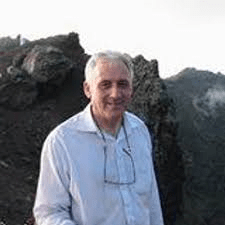
val-martin“Congratulations to Val Martin, who took on An Bord Pleanala in the High Court and won. This amazing achievement is testimony to the fact that it is possible for a person, with no formal legal training, but with bucketloads of planning knowledge and guts, to take on the State apparatus in the High Court and win.”   Republic of Ireland

Reblogged:  https://the-law-is-my-oyster.com/2016/10/17/well-done-val/

Here is the story in Val’s own words:

“In 2009, the predecessor to Raragh developments applied for planning permission for a wind farm at Kingscourt. Cavan 09/270, It supplied an Environment Impact Statement (EIS) (of sorts). Despite objection from 38 households the Local Council granted permission and it was appealed to ABP. They carried out a sort of EIA and granted planning permission.  As the developer did not know details of the cables at the time, a specific condition was that the planning permission did not include the connecting cables.

In 2015, the developer applied to extend the period of operating time for the wind farm until 2020. He stated that an EIS has been provided with the first application and Cavan Co. granted the application stating that an EIA had been done in 2010.  In May 2015, the developer applied for a declaration under Section 2 of the PDA to declare the 5.5 km of underground cables to the ESB sub-station in Kilnalun, Co. Meath to be development and exempted development.     Cavan Co. Council referred it to ABP (No.RL . 02. 3369).

On the 3rd May, 2016, the Board stated that it was a “development”  and “an exempted development”.  This would have allowed the whole work to go ahead.

I took a judicial review No 2016/460/JR acting as a lay litigant (presenting the case myself). I claimed that the underground cabling was not a “development” but a “project” and accordingly it could never be classed as an exempted development.  I cited the O’Grainne judgment and its ratio decidendi (binding part of the judgment) where the Judge said “In truth I have already concluded the wind farm and cabling are one project”.    I cited a few European cases which proved that a project can be split into phases and that the 2nd or subsequent phases must be assessed under the EIA Directive. In other words, when deciding whether its environmental effects are acceptable, it must be assessed with the cumulative effects of the entire project, and not just the phase currently under consideration.

The Board and the wind farm developer opposed me. They served me with a cart load of documents and I simply wrote in the legal submission that the High Court has no role to play in assessing planning applications, but must confine itself to the law alone.    The Board Lawyers, Philip Lee and Co. caved in and the developer’s lawyers did too.    The Barrister for the Board arrived in Court No 1 before Judge McGovern and said “this is the man who beat Board Pleanala” in a good humoured way.  There was no need for the 2-day trail which had been allocated.

The Judge said he would quash the decision of the Board and award me costs.  

Should anyone want copies my case and legal argument, just ask and I will send to you as hard copies. I acknowledge the help of Pat Swords, David Malone, Owen Martin, Francis Clauson, committee chairman Mike Muldoon, Dublin solicitor (and friend) George McGrath , campaigners all over the country and neighbours at Kingscourt for their encouragement.

Essentially the law is:

1) projects cannot be developments.

2) Projects can be split but all information known should  be provided at each phase.

3)   Projects cannot be processed under the PDA alone.

4) The PDA (part X) is the vehicle for processing an EIA.

5) One major cop,  well spotted by David Malone and used by me is that Article 2(4) of the EIA Directive allows for exemption a project from an EIA in exceptional circumstances.   If this is done government must inform the EU Commission and comply with a number of conditions which are very strict.  I think this would cover situations like where there is some sudden and unforeseen important event where development would have to be done without submissions for the public.   An international summit or the like.  This is the only way a project can be exempted.

The developer’s lawyers indicated that they did not want to remit the application to the Board. I do not know if they will now apply for an EIA for the cables and planning permission, that is for another day.

Regards

Val Martin”

Well done Val.  Respect!


Impact of Wind Turbines on Well Water

golder-report

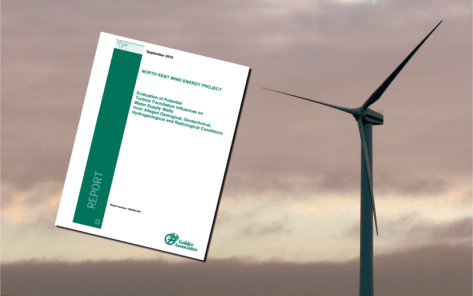
The Golder report has been released but fails to provide any insight into why there are reports of water wells adversely impacted after wind turbines were installed for other projects. The paper insists ground vibrations will have insignificant impacts to water wells. Real life experience demonstrates a different and negative outcome with water being contaminated by excessive sedimentation. Desk top study vs actual reported changes to wells on the same aquifer of the proposed project. It would be fantastic if harm is not proven. Don’t bet the farm on that one.

READ ARTICLE HERE:  http://sydenhamcurrent.ca/2016/10/13/full-golder-report-obtained/

Golder Report:


Remedy Hearing Cross-examination of wpd witnesses

appec's avatarAlliance to Protect Prince Edward County

Report on Remedy Hearing for White Pines wind project
Cross-examination of wpd witnesses on September 29, 2016 
by Paula Peel

Shawn Taylor
APPEC legal counsel Eric Gillespie questioned Mr. Taylor on a series of exhibits from the Amherst Island ERT, where Mr. Taylor recently testified for the wind developer.  Mr. Gillespie’s questions were repeatedly blocked by wpd’s legal counsel, Mr. Duffy who indicated that wpd would object to any document that Mr. Gillespie referred to from the Amherst Island ERT.  Mr. Duffy also directed their witness, Mr. Taylor, to not respond to any questions relating to Amherst Island, even the simple question whether one of the issues that came up at those hearing was the location of Blanding’s turtles on the island.  The transcript shows twelve refusals by wpd during Mr. Gillespie’s cross-examination of Mr. Taylor.  Mr. Gillespie noted that there was no mechanism for dealing with refusals and…

View original post 495 more words

Boiling Point Reached Over Testing Delays On Port Elgin Wind Turbine

Continued delays of acoustic testing of the Unifor wind turbine in Port Elgin has Saugeen Shores council sounding off.

Council is filing a complaint with Ontario Ombudsman Paul Dube regarding the Ministry of Environment and Climate Change’s promised testing of the turbine, which has not yet been completed.

Deputy Mayor Luke Charbonneau says the MOECC originally told council they would have the acoustic audit completed by June of this year, but adds it has been delayed at least three times since then, with the Ministry now saying the audit won’t be completed until at least next summer.

He says a sound testing company has been conducting preliminary data in the area of the turbine, which is located at Unifor’s Family Education Centre at the south end of Port Elgin, although that data has not been shared with either the MOECC or the municipality.

“We don’t know what the results of those tests have been, we have no audit, [MOECC] doesn’t know, so what’s going on?   It’s really simple to me, we need to know if this turbine is operating in compliance with the law,” says Charbonneau.

Charbonneau says the MOECC is blaming weather, a lack of wind and turbine down-time as the reasons for the testing delays.

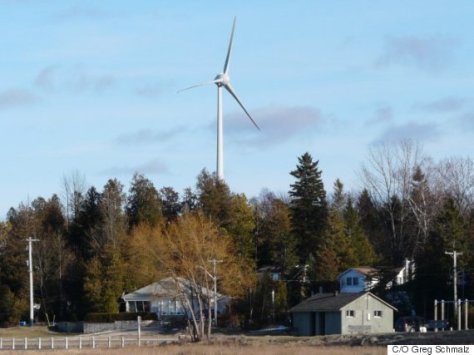
Charbonneau’s home is one of more than 100 homes and cottages located within the 550-metre setback typically required for industrial wind turbines, though he says his family has not had any issues with the operation of the turbine, other than one complaint regarding shadow flicker, which was resolved.

Charbonneau says more than 50 complaints regarding the turbine’s operation have been received since February, most recently two weeks ago when a resident complained of the turbine making a thumping noise.

The 250-foot Unifor wind turbine was constructed by what was then the Canadian Auto Workers Union in 2012 and went into service a year later.

READ AT: http://blackburnnews.com/midwestern-ontario/midwestern-ontario-news/2016/10/13/boiling-point-reached-testing-delays-port-elgin-wind-turbine/

Vermont cabin becomes lab to study wind turbine noise

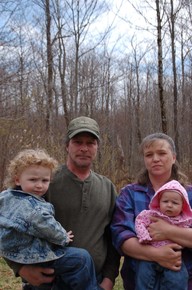
“Deep in the night, when things were quiet on the highway, a low hum came from the opposite direction, punctuated occasionally by louder noises, the Therriens say. Soon, they say, they and their two small children were plagued by sleeplessness, nausea and other problems.”

therriensSHEFFIELD, Vt. (AP) — Once it was just another cabin on a Vermont hillside. Now it’s an emblem in the debate over noise from the growing wind energy industry.
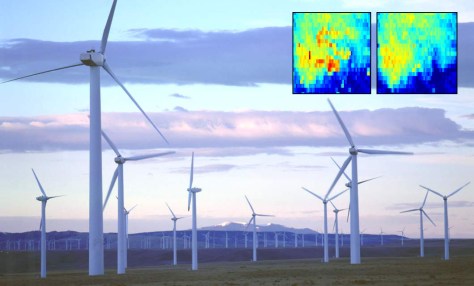
Studies have repeatedly found no evidence connecting noise from wind power turbines to human health problems. But critics question the soundness of those studies. Among them are Steve and Luann Therrien, who say a wind farm near their home made their lives hell.

The case has created a fissure among environmentalists in this liberal state with a reputation for green thinking, pitting those who see wind energy as key to reducing reliance on pollution-spewing fossil fuels against those convinced audible noises and inaudible “infrasound” present health threats to those living nearby. And each side questions the objectivity of the other’s research.

The Therriens’ old cabin is up 5 miles of dirt road from town, but is just a quarter-mile from a rural stretch of Interstate 91. The highway noise largely didn’t bother them.

But after the 16 turbine towers of the Sheffield Wind Project went up on a nearby ridgeline in 2011 — the closest about three-quarters of a mile away and five within a mile — things changed, the Therriens say.

READ AT: http://bigstory.ap.org/article/2827437f49bd43b196bc07f4917a97bd/vermont-cabin-becomes-lab-study-wind-turbine-noise

Wind Turbine Signals Hinder Radar

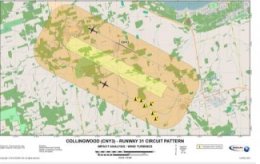
radar-clutter“Radar technology is built for detecting any moving object hence the spinning turbine blades often create interference, thereby degrading the available signal. The wind turbines often reflect signals back to the radar system, thus leaving a blank spot.”
READ ARTICLE ABOUT INCREASING MARKET FOR RADAR INSTALLATIONS: http://ein.iconnect007.com/index.php/article/100400/increasing-terrorism-worldwide-compelling-nations-to-install-advanced-military-radar-systems/100403


Canadian Airports Get Turbine Relief

collingwood-clearview-mapBy Russ Niles | October 9, 2016

The Canadian Owners and Pilots Association (COPA) has announced a major decision that may help ensure that Canadian airport operations are not hampered by wind farms. It had a little help from some bats, too. Ontario’s Environmental Review Tribunal has ruled that a proposed wind farm would potentially “harm human health” by creating obstacle hazards in the pattern for Collingwood Regional Airport in southern Ontario and Stayner aerodrome, a privately operated airstrip a few miles away. “This is precedent-setting,” said COPA President Bernard Gervais. COPA spent more than $175,000 fighting a plan to build eight 500-foot wind turbines within two miles of the airports. Local municipalities and private individuals also fought the proposal. The turbines were planned for the downwind of the main runway at Collingwood, the major regional airport in that area of Ontario, and would have also caused conflicts for Stayner, which is a privately owned “aerodrome” operated by an aviation business but open to the public.

The tribunal decision was literally the last resort for opponents to the project, which was approved by the Ontario government under its Green Energy Act legislation last February. The Green Energy Act essentially invalidates any land use, property value or nuisance claims by local governments or individuals in its approval of alternatives to fossil-fuel energy. Approvals can only be overturned on environmental grounds and threats to human health are among those concerns. The opponents hung their case on the fact that colliding with a wind turbine on downwind would indeed be harmful to human health and the tribunal agreed. The Ontario government and the company proposing the project, wpd Fairview Wind Incorporated, argued the windmills could be accommodated by adding a right-hand pattern at Collingwood but the tribunal agreed that right-hand patterns are less safe than standard patterns and the alternative wasn’t reasonable. Transport Canada, which could have rejected the project before anyone spent any money opposing it, instead took a hands-off approach but suggested there would be limitations on the airports’ operations if the windmills were permitted. But it’s not just airplanes that are in danger of running into the turbines. The tribunal also found that the little brown myotis, an endangered species of bat, could bash into the big blades and diminish their numbers even further.

READ AT: http://www.avweb.com/avwebflash/news/Canadian-Airports-Get-Windmill-Relief-227088-1.html

WE WON! Clearview appellants successful

“[5] For the reasons that follow, the Tribunal finds that the Appellants have satisfied the health and environment tests under s. 145.2.1(2)(a) and (b) of the EPA and further adjourns this hearing under O. Reg. 359/09, s. 59(2)1.ii to determine the next steps in this proceeding. “

Remedy hearing is the anticipated next step.  Read the decision here:


Blue Water Hears about Health Study

wind-turbine-autumn-540x400Bluewater Council Hears From Wind Concerns Ontario

Councillors with the Municipality of Bluewater now have a better understanding of a wind turbine study that’s just beginning.

Warren Howard, a director with Wind Concerns Ontario, appeared before council Monday night to outline the study they are conducting with the University of Waterloo and the Huron County Health Unit.

Howard explained the goal of the study is to determine if there is a link between wind turbine noise and the symptoms being reported by people who live near them.

Many of the studies so far have been focused on audible noise, but Howard says there are other types of noise created by wind turbines and their study will look at the full spectrum of noises.

As part of the presentation, Howard asked for a letter of support from Bluewater council, and that was granted.

Howard is hoping they’ll be able to collect significant data within six months from which they can draw some conclusions.

READ ARTICLE: http://blackburnnews.com/midwestern-ontario/2016/10/04/bluewater-council-hears-wind-concerns-ontario/

Wind Turbines and Human Health

hearing

A Four-Decade History of Evidence that Wind Turbines Pose Risks

Jerry L. Punch i, Richard R. James ii

Abstract

Many expert-review panels and some individual authors, in the U.S. and internationally, have taken the position that there is little literature to support concerns about adverse health effects (AHEs) from noise emitted by industrial wind turbines (IWTs). In this review, we systematically examine the literature that bears on some of the particular claims that are commonly made in support of the view that a causal link is non-existent. Investigation of the veracity of those claims requires that multiple topics be addressed, and the following specific topics were targeted for this review: (1) emissions of infrasound and low-frequency noise (ILFN) by IWTs, (2) the perception of ILFN by humans, (3) the evidentiary bases for establishing a causative link between IWTs and AHEs, as well as the physiological bases for such a link, (4) recommended setback distances and permissible noise levels, (5) the relationship between annoyance and health, (6) alternative causes of the reported health problems, (7) recommended methods for measuring infrasound, (8)foundations for establishing a medical diagnosis of AHEs due to IWTs, (9) research designs useful in establishing causation, (10) the role of psychological expectations as an explanation for the reported adverse effects, (11) the prevalence of AHEs in individuals exposed to IWTs, and (12) the scope and quality of literature addressing the link between IWT noise and AHEs. The reviewed evidence overwhelmingly supports the notion that acoustic emissions from IWTs is a leading cause of AHEs in a substantial segment of the population.

i Professor Emeritus, Department of Communicative Sciences and Disorders, Michigan State University, East Lansing, MI, USA

ii E-Coustic Solutions LLC, and Adjunct Professor, Department of Communication Disorders, Central Michigan University, Mt. Pleasant, Michigan, USA

Download Article:  http://hearinghealthmatters.org/journalresearchposters/