Province gives greenlight to wind farm

Niagara region Wind Corp’s turbines to be largest in North America

The largest turbines in North America will soon rise over West Lincoln.

turbine sizeOn Thursday, the provincial government announced it had approved Niagara Region Wind Corporation’s renewable energy application to operate a 77-wind turbine project in the West Lincoln area. The announcement was made the same day that Health Canada released results of its study into the impacts on human health from industrial wind turbines which concluded with the findings of Ontario’s chief medical officer of health, Dr. Arlene King, in 2010.
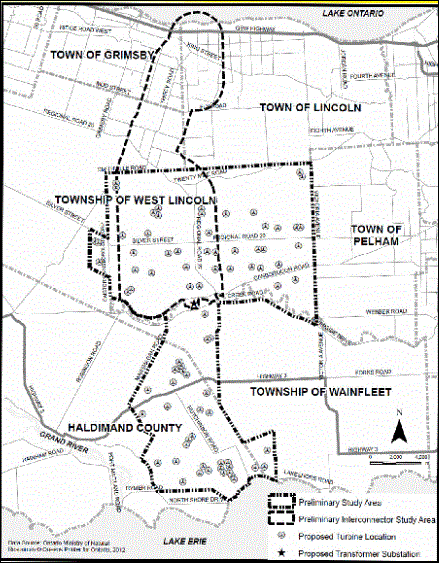
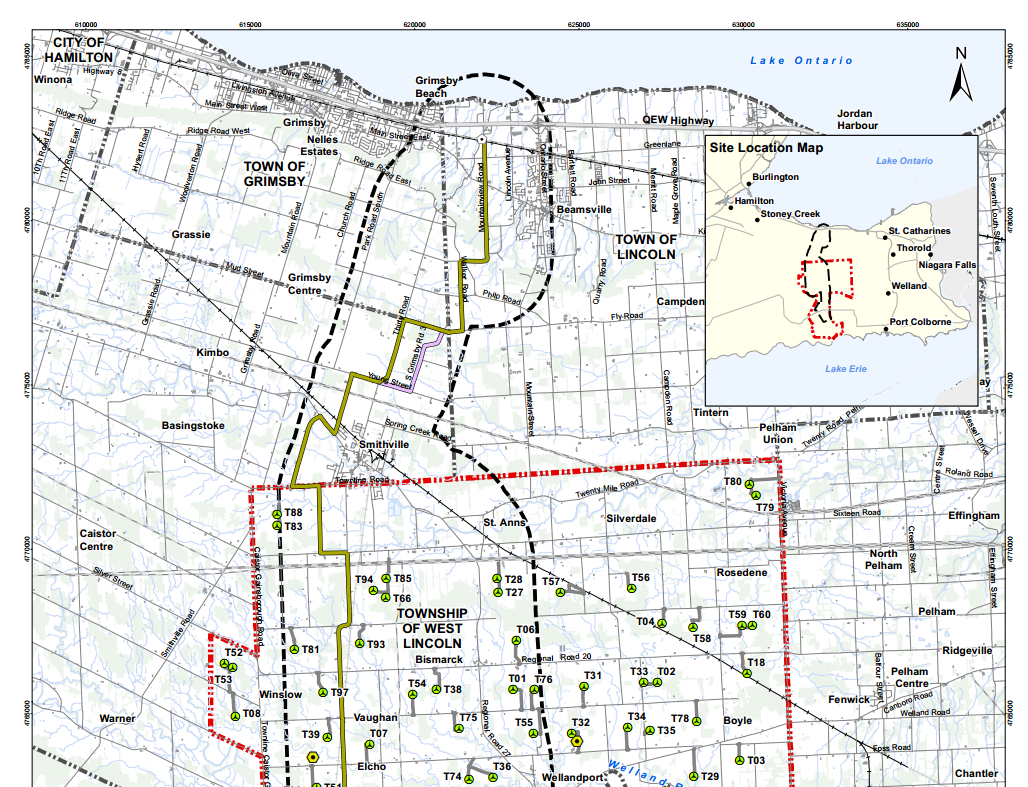
turbine mapHealth Canada’s assurances however do little to calm the fears of those living in the project’s vicinity.

“The real problem is the health issues for the people in the footprint of the project,” said Catherine Mitchell, who herself lived in the project area before moving to Welland. She is a board member with Mothers Against Wind Turbines which will hold an emergency meeting as it now has 14 days to launch an appeal.

“It’s been approved by the Ministry of Environment but not by the people impacted by this decision,” Mitchell added, noting there were 2,572 comments on the application listing concerns ranging from property values and health impacts to rising energy costs and environmental impacts. “The concerns go on and on for pages.”

Mitchell, who is most concerned with low frequency sound and has been studying it, said she was shocked and awed by the government’s approval.

West Lincoln Mayor Doug Joyner said he was also surprised to see the approval come this soon.

“We expected this to come through but we didn’t expect it until after Christmas,” said Joyner. “It’s a little sooner than expected.”

The ministry’s approval doesn’t come without stipulations however, and Joyner said the township would do what it can to ensure NRWC adheres to the rules and regulations.

As a result of comments received by the municipality and local residents a condition of the approval requires Niagara Region Wind Corporation to:

  • •   not construct or operate more than seventy-seven out of the eighty wind turbine generators identified in the approval
  • •   comply with the ministry’s noise emission limits at all times
  • •   carry out an acoustic emission audit of the sound levels produced by the operation of the equipment at five receptors
  • •   carry out an acoustic emission audit of the acoustic emissions produced by the operation of two of the wind turbine generators
  • •   manage stormwater, and control sediment and erosion during and post construction
  • •   develop and implement a pre- and post-construction ground water monitoring program
  • •   carry out specific items if foundation dewatering or water takings by tanker exceed 50,000 L/day
  • •   apply the Department of Fisheries and Oceans Operational Statement, if during construction, waterbodies that were previously not identified are discovered
  • •   design, construct and operate a spill containment facility for each of the Transformer Substations
  • •   implement the pre and post construction Natural Heritage monitoring program, which includes bird and bat monitoring
  • •   undertake the supplementary monitoring program discussed with Environment Canada and determine next steps as part of the program including the implementation of mitigation measures in response to any potential unanticipated adverse effects
  • •   ensure that activities requiring authorizations under the Endangered Species Act are not commenced until authorizations are in place
  • •   create a Community Liaison Committee with members of the public and applicant
  • •   undertake ongoing Aboriginal consultation and fulfill all commitments made by it
  • •   prepare a Traffic Management Plan to be provided to the upper and lower tier municipalities, and
  • •   notify the ministry of complaints received alleging adverse effect caused by the construction, installation, operation, use or retirement of the facility.

A representative of NRWC was not immediately available for comment. Check back for updates.
The Standard, Grimsby Lincoln News By Amanda Moore

Wynne government approval of Niagara Region Wind worst energy decision in years

It’s been a tough week for some fighting Ontario’s wind whimsy: part one

I co-wrote a piece with Parker Gallant that was put out by Wind Concerns Ontario on Wednesday, which received some attention before Health Canada released conclusions from a study regarding people and wind turbines the next day as Ontario’s government approved the Niagara Region Wind Corporation (NRWC)project to erect 77 of the “largest turbines in North America” in West Lincoln. I hope to cover all these things today, but I must start with the NRWC decision, because I had planned to communicate why this rose to be the worst planned wind project after the contract for Big Thunder was eliminated – which was after I’d written that it was a big mistake.

The NRWC project is poor because of the environment it occurs within. The project was offered a feed-in tariff (FIT) contract on February 24th, 2011. At that time there was speculation this was a petulant award, placing industrial wind turbines in the opposition leader’s riding shortly after suspending the possibility of turbines off the coast of the energy minister’s riding. Said that minister at the time:

“Ontario could have taken the easy route and we could have not have made these critical investments – that was the advice of, frankly, both opposition leaders here in Ontario who have demonstrated a remarkable lack of leadership, fortitude and commitment when it comes to building a clean, reliable and modern energy system,”

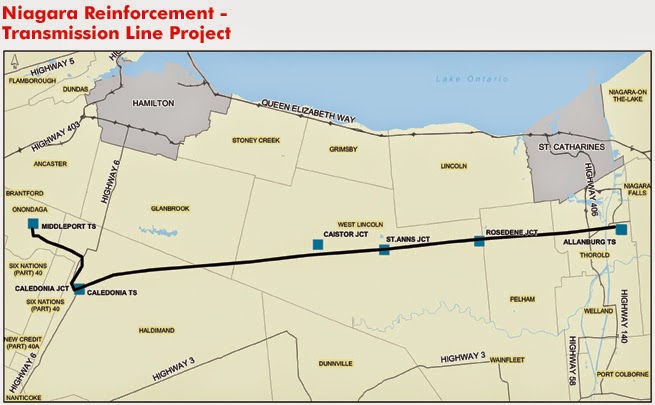
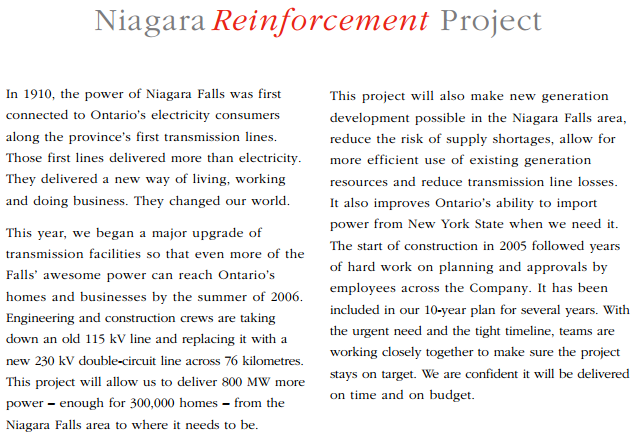
NiagaraReinforcementLet’s talk about leadership, fortitude and commitment again – as I did inwasted on the traditional territory of the Mississaugas.

The NRDC project is located to the north of a transmission line the government has avoided entering into service for many years. That line was seen critical to increased trade, and growing the ability to “deliver 8000 MW more power … from the Nagara Falls area to where it needs to be.”

I’ll try to show, with 2 maps, how the non-completed transmission project and the NRWC project relate.

map_niagaraThe Niagara reinforcement line runs east west (it’s not connected because of a nonsense, and the nonsensical response to nonsense, outside Caledonia).

Hydro One is essentially required to provide renewable energy projects access to the grid, so the NRWC project will connect by crossing the inactive Niagara Reinforcement line south to Lake Ontario where Hydro One will dutifully construct capacity to accommodate the “renewable” energy project.
NRWCThe generation project planned in conjunction with the Niagara Reinforcement line, was a tunnel to increase the output of Niagara Falls. It was announced “in-service” March 2013. I upset some people I respect when I wrote on generation not improving anywhere near the extent expected (if at all) and attributed that failure to the transmission reinforcement project not getting done.
Unfortunately, nobody did explain how I was wrong and why the tunnel wasn’t increasing output.

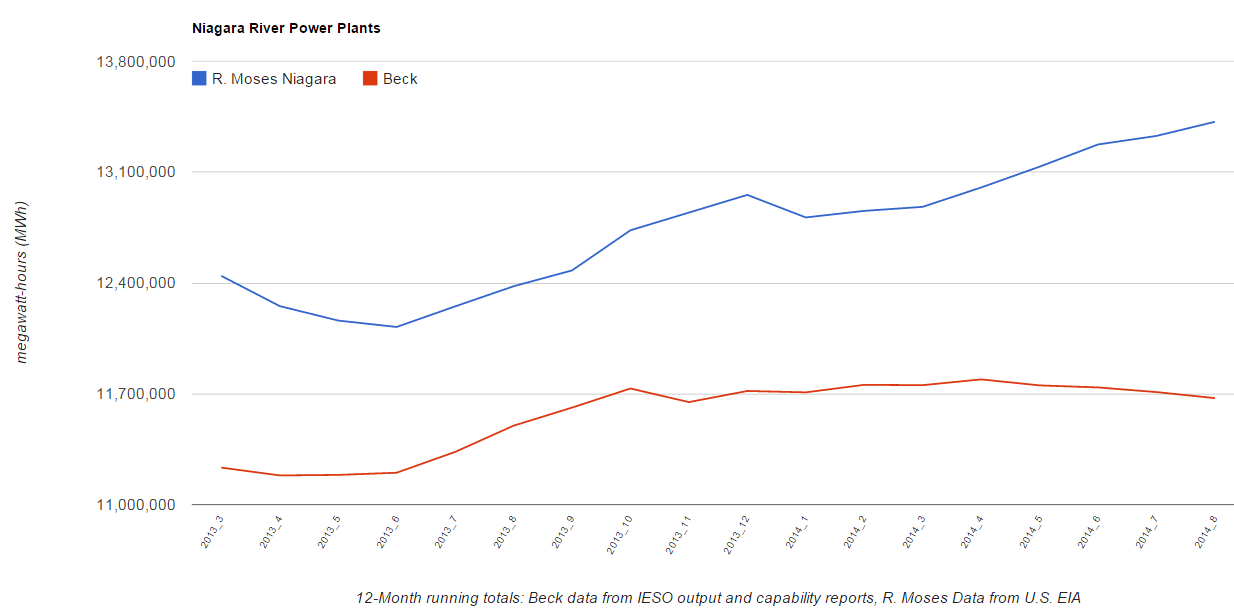
Here is an update on how 12-month running total generation has changed since, with a comparison to the facilities on the U.S. side of the river. (I understand that water rights are equal):

NiagaraPP (1)
Oops! The upgraded Canadian side isnt’ getting more power, but the American side is benefiting from the higher lake levels recently. It not only continues to look like the legacy asset beraing Sir Adam Beck’s name are underutilized due to transmission restraints, it looks more likely today than ever before.We don’t improve transmission for trade and to access affordable public power assets anymore – just for hugely expensive and often unnecessary generation from private party funders/power producers.

It would be lovely if it was possible to teach Brad Duguid what “ fortitude and commitment ” can be. Given Ontario’s kangaroo courts – which includes its real ones – I doubt that’s possible, but if you have faith, I know the Smithville Turbine Opposition Party would welcome support.

MOH Disappointed in Turbine Study

Dr Lynn says more information is needed on Health Canada study.

page_Wind_Turbines_110The Medical Officer of Health for Grey Bruce is disappointed with a Health Canada report on wind turbines.

Doctor Hazel Lynn says the study leaves a lot of questions unanswered, including how the study was conducted.

Health Canada says it found no evidence linking exposure to wind turbine noise and health effects reported by people living near the towering structures.

However, the study did find a relationship between increasing levels of wind turbine noise and residents’ annoyance related to noise, vibration and shadow flicker from the structures.

The year-long study included a detailed questionnaire to adults in more than 1,200 households in southwestern Ontario and P.E.I. living at various distances from almost 400 wind turbines.

It explored the relationship between exposure to noise and health effects reported by people living near wind turbines.

Doctor Lynn wonders if the people questioned in the study were compared to people living a further distance away, and also what Health Canada means by saying there is a link between wind turbine noise and residents annoyance.

She says it doesn’t have a definition and we don’t have a way of measuring it.

Overall, the MOH says she doesn’t know what to make of the study without more information.

The Health Canada report concludes by saying the study alone cannot provide definitive answers and more research may be needed.

Bayshore Broadcasting, Friday, November 7, 2014 by Kevin Bernard

Wind Turbine Noise and Health Study: Summary of Results

*(the results are being reviewed and further commentary will be available)

Capture


http://www.hc-sc.gc.ca/ewh-semt/noise-bruit/turbine-eoliennes/summary-resume-eng.php

Good day:

As you know, we informed the membership earlier today that a summary report of Health Canada’s wind turbine noise study (also called the community noise study) was to be released this morning.

We intend to undertake a detailed study of this summary report, together with information we hope to get at a meeting with Health Canada, and prepare a formal response.

However, as of this morning, we can say that we are very disappointed in the summary of results, that we have deep concerns about the methodology and conclusions and that, finally, these results do not reconcile with either the experience of Ontario communities, or other peer-reviewed research.

You may view the study summary report here: http://www.hc-sc.gc.ca/ewh-semt/noise-bruit/turbine-eoliennes/index-eng.php

Jane Wilson

President

Wind Concerns Ontario

NRWC WIND TURBINE PROJECT APPROVED FOR WEST LINCOLN, WAINFLEET AND HALDIMAND

bring-itIt is with great sadness that we post this advisory to you.  Today the Ministry of Environment and Climate Change approved the Niagara Region Wind Corporation industrial wind turbine project for West Lincoln, Wainfleet and Haldimand.
  If you wish to view the approval notice, you can click on the link that is provided below. 

MAWT Inc is committed to challenging the approval but financial assistance is required to make that happen.  If you have not donated yet, cheques can be mailed to:  

Mothers Against Wind Turbines Inc.
Box 132
Wellandport, ON
L0R 2J0 

Abandoned Homes Help Understand Wind Turbine Annoyance

stopthesethings's avatarSTOP THESE THINGS

William Palmer Bill Palmer

At the recent 168th Meeting of the Acoustical Society of America, a session was dedicated to research papers related to wind turbine noise and noise standards. Here are the slides and notes from one of these presentations – made by William Palmer, a Professional Engineer based in Canada who listened to what people were saying and used their abandoned homes to better understand the annoyance from wind turbines.

Wind Turbine Annoyance – a clue from acoustic room modes
William Palmer
Acoustical Society of America
29 October 2014

01

Abstract

When one admits that they do not know all the answers and sets out to listen to the stories of people annoyed by wind turbines, the clues can seem confusing. Why would some people report that they could get a better night’s sleep in an outdoor tent, rather than their bedroom?

Others reported that they could sleep better in the basement recreation room…

View original post 3,715 more words

How Green is this celebrating 5 years Turbine Free!

There is going to be a celebration and we hope you can make it!

spaghetti-dinner-cropHow Green is This is hosting a Spaghetti Dinner Supreme and we hope you will be our special guests. This is indeed another Fundraiser – what would we do with all the time on our hands after Wind Sale? – but it is a FUN one.

We want to thank you for everything you’ve done and have fun too.

Our Green Team Mama’s are cooking their best-ever secret sauces, meat and veggie.

spaghetti-dinner-info-jpg

How Green Is This


Winning The War of Words- Wind Warriors Voices are Being Heard

This from Renewable Energy Magazine.

 [Anti-wind sentiments can attract supporters near and far even though a community, province, or country favors the use of renewable sources as a whole. The silent majority of supporters must be awoken to counter the misinformation and let public officials know they favor a transition to renewable power in their community. Without a strategic plan to build support from the start, wind projects in Ontario will continue to experience the wrath of a well-connected and organized opposition network.]

Supporters of Wind just might be surprised when they realize that the “silent majority” turn out not to be in support of wind but a well educated public BECAUSE of a well-connected and organized network!!  Well done Wind Warriors!  Proof that there is indeed strength in numbers…

Ontario Wind Proposals Increasingly at Risk for Public Defeat

A 2013 study conducted by The Environics Institute found that in Ontario, 68 percent of residents held the belief that their province could make the shift from fossil fuels to renewable power. Despite this majority of those surveyed, Ontario has experienced considerable controversy over the implementation of renewable policies since the Green Energy Act of 2009, and Premier Kathleen Wynne’s pro-wind initiatives continue to generate public scorn at speaking engagements on unrelated topics.

From Ontario residents’ wider perspectives, it seems that a transition to renewable energy is ideal. However, once a wind project is proposed in residents’ own backyards, public opposition forms to bring the project to a screeching halt. Despite the political support that exists on a macro-level, careful measures must be taken locally to build the support necessary to guide the project through the approval process with ease.

Despite an extensive two-year approval process with various environmental studies conducted, opponents of a 140-turbine wind proposal by K2 Wind in Goderich, Ontario recently filed a construction stay application to halt the project in its tracks.

The injunction filed intended to allow for the completion of a Health Canada study, which seeks to understand the impact of industrial wind projects on nearby residents. Already anti-wind groups have been successful on placing a moratorium on off-shore wind until the potential for impacts on marine life are identified.

However, Divisional Courts sided with K2, noting the “serious financial consequences” the company will suffer as a result of a minor delay in construction in contrast to the “lack of harm appellants will suffer” without granting their motion. Despite K2’s narrow escape of costly delays in this case, the opponents’ efforts continue.

When the $850 million K2 project was permitted, the Environmental Review Tribunal upheld approvals finding no evidence of health hazards imposed upon residents living near turbines. However, opponents of the K2 project have joined together with opponents of a 92-turbine Armow wind farm near Kincardine, Ontario and a smaller St. Columban project to appeal the Tribunal’s findings, which the group collectively claims violates their constitutional rights due to the potential health impacts.

A decision in this appeal is expected later this month. While Ontario looks on to see what will happen to K2 and future wind proposals in the province, these cases demonstrate opponents’ abilities to band together to impact the success of a proposal at any stage of development.

Anti-wind sentiments can attract supporters near and far even though a community, province, or country favors the use of renewable sources as a whole. The silent majority of supporters must be awoken to counter the misinformation and let public officials know they favor a transition to renewable power in their community. Without a strategic plan to build support from the start, wind projects in Ontario will continue to experience the wrath of a well-connected and organized opposition network. Continue reading Winning The War of Words- Wind Warriors Voices are Being Heard

Adverse Health Effects from Industrial Wind Turbines

Negative Health Effects of Noise from Industrial Wind Turbines: Some Background

This article, the first of three installments, provides a broad overview of the topic. The second installment will review the major research findings linking low-frequency noise and infrasound from industrial wind turbines with effects on health and quality of life, and the third will discuss the relationship between various health effects and the processing of infrasound by the ear and brain.[1]

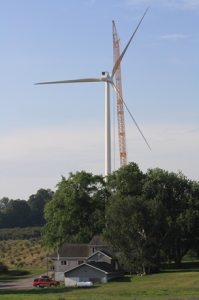
Figure 1-An industrial-scale wind turbine during installation near the Shineldecker home in Mason County, Michigan.

By Jerry Punch, PhD, and Richard James, INCE, BME

Cary Shineldecker was skeptical about the wind project the Mason County, Michigan, planning commission was considering for approval. His home, two miles from Lake Michigan, was located in an area where nighttime noise levels were around 25 dBA, with only occasional traffic and seasonal farmland noises. The rolling hills, woodlots, orchards, fields, and meadows surrounding his property contributed to its peaceful country setting. He voiced his skepticism about the wind turbines repeatedly in community meetings held beforeConsumers Energy was finally granted approval to construct 56, 476-foot, turbines that would place one turbine 1,139 feet from his property line (Figure 1), six within 3,000 feet, and 26 that are visible from his property.

He and his wife Karen started to suffer symptoms of ear pressure, severe headaches, anxiety, irritability, sleep disturbance, memory loss, fatigue, and depression immediately after the turbines began operating.

Continue reading Adverse Health Effects from Industrial Wind Turbines

O!M!G! Wynnes new $400M Trade Deal in China is with … WAIT FOR IT!!!! … A COAL COMPANY!!!!

Donna Quixote's avatarQuixotes Last Stand

Tip o’ the hat to Glenn for this revelation!!!

From Kathleen Wynne’s FB page:

“The China trade mission has confirmed that Greenland Group is investing $400 million in Ontario and will create up to 200 new Ontario jobs!”

How wonderful.  I wonder what the Greenland Group does!!   DIRECT FROM THEIR WEBSITE:
“At present, Greenland Group has formed a complete industrial chain including production, processing, storage, transport and distribution of coal as well as storage, transport, trade and retail of petroleum, and owned several coal mines in Inner Mongolia and Shanxi Province, with gross resource reserve amounting to 700 million tons, annual output of more than 13.5 million tons, and distribution amount of over 55 million tons.
As for the product deep-processing field, Greenland Group has successfully acquired a coal deep-processing project in Dandong, Liaoning Province and a petroleum production-supply-marketing integration base in Zhoushan, Zhejiang Province, both of which substantially…

View original post 107 more words